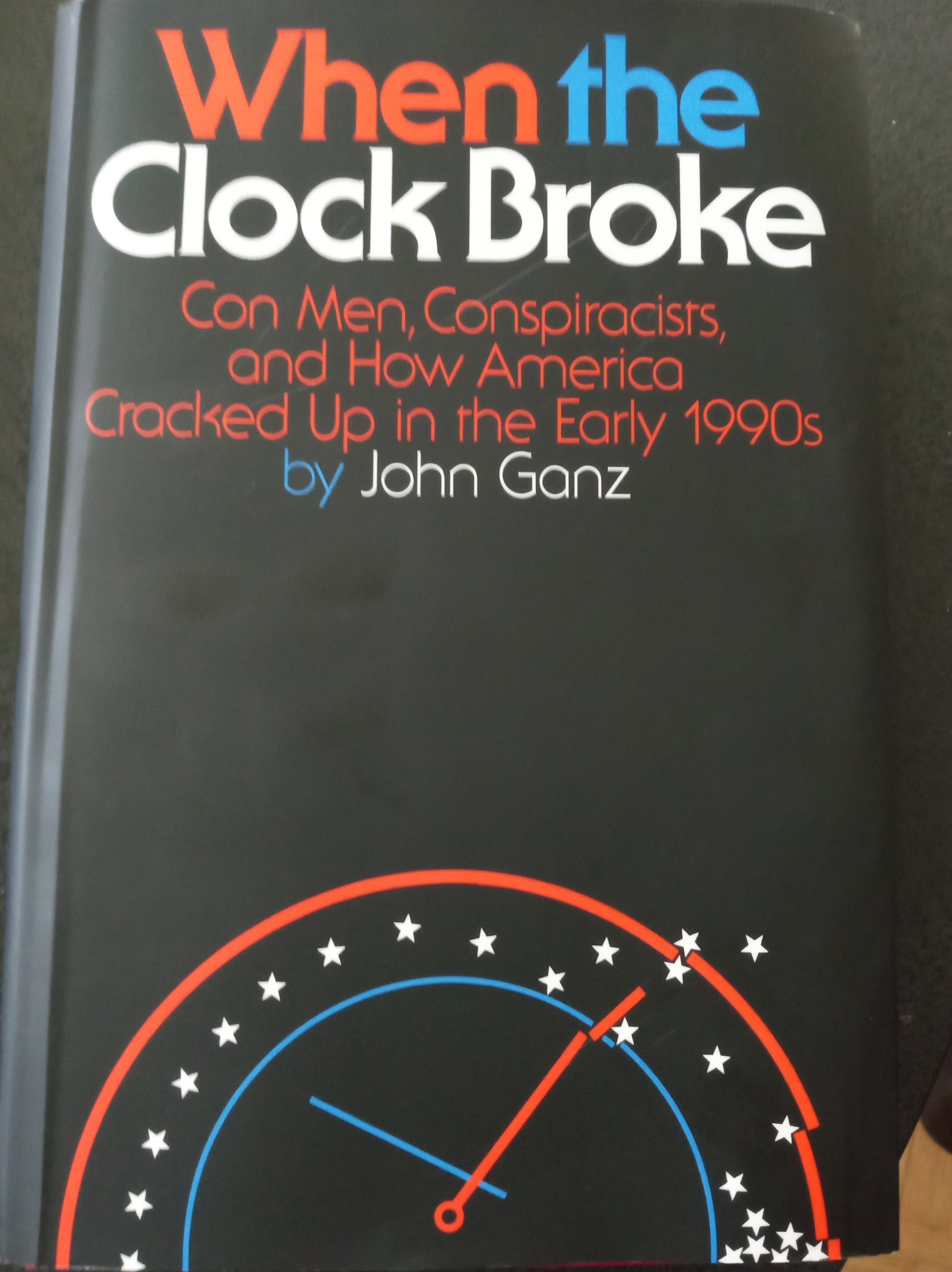
John Ganz is a trending young writer on the left with a history bent, and his new book from Farrar, Straus and Giroux, “When the Clock Broke,” is largely a political recapitulation of 1992 in the U.S. His angle is that the populist resentments of today’s MAGA America were present in that late-recessionary year, in which the country, having emerged triumphant in the Cold War, turned in on itself. (For his own fuller explanation, you can pay for his Substack feed.)
That’s an interesting proposition, placing the origins of the current distemper earlier than most others do. (Some trace them all the way to Andrew Jackson in 1828, but that’s a different discussion.) Obviously the Ross Perot phenomenon of 1992 and the related crack-up of the Reagan Republican Party under George H.W. Bush is a major flag for Ganz’s argument, and he mines the period for other useful omens (Pat Buchanan, Rush Limbaugh, Howard Stern).
Unfortunately, the author has a subsidiary aim and that is to find strands of fascist white supremacy in the unfolding drama back then (and naturally, now). So he references David Duke scores of times. The brief Louisiana legislative career of the former Klan wizard was ending as 1992 began, but Ganz sees his enduring influence in many places. My own memory of Duke is that he was a fluky, flaky presence in American politics, a footnote now like so many others of his kind. I had to check whether he was still alive.
That’s not Ganz’s only rediscovery. Murray Rothbard was an economist and cult favorite of libertarians for most of his career, until he veered into Southern populist swamps through the Ron Paul network. He merits a solid six pages–including a raring speech that inspires the book’s title–and a few other mentions. Just as obscure by general circulation was the paleoconservative writer Sam Francis, whose Manichean and racialist views are recited dozens of times, into the book’s final paragraphs. A forerunner of Steve Bannon? I don’t want to minimize the influence of the small, intellectual press but I don’t think Donald Trump would have ever read Francis, even if he had read at all.
I’d like to see more discussion of the angry populism of the time that was bipartisan. One target of this ire was NAFTA, the North American Free Trade Agreement, which Ganz notes briefly. He is good enough to record the fact that most congressional Democrats, and not Republicans, opposed the treaty when finally passed in 1993. I recall that year witnessing a union rally against the trade deal–held at the Port of Los Angeles by my own newly elected representative, Jane Harman. She would go on to rank as a notable globalist, but was not above a bit of pandering to Perotism then.
One other objection, a frequent and self-interested one of mine when it comes to pop histories of the modern American right. The Wall Street Journal’s editorial pages are cited once by Ganz, an apparently early (1989) gibe at Rudy Giuliani as a mayoral candidate.* The Journal was, during the period at issue, the largest-subscription newspaper in the U.S., and its opinion pages (which employed me then) were a bible for millions of conservatives. Arguably, its sentiments might have helped shape those times, in that camp at least? It is likely Ganz’s view that the “Wall Street” Republicanism often ascribed to the Journal’s editorials has been surmounted and supplanted by the movement he is writing about. That’s a fair position. But to have the Washington Times, by contrast, referenced on 16 pages is a bit skewed in this retrospective. Even if that narrowly targeted broadsheet did at the time employ the estimable Sam Francis!
Those reservations notwithstanding, I am glad to see a gifted next-gen writer draw on evidence from the analog era. Historical cycles do stretch, and then of course we are doomed to repeat them. I wonder what fruit today’s time capsules will bear. –July 15, 2024
*The actual citation is not included in the notes, but Giuliani at the time was still fresh off his prosecutorial frog-marching of investment bankers and conviction of Michael Milken, none of which endeared him to Journal editorialists.
 Tim W. Ferguson