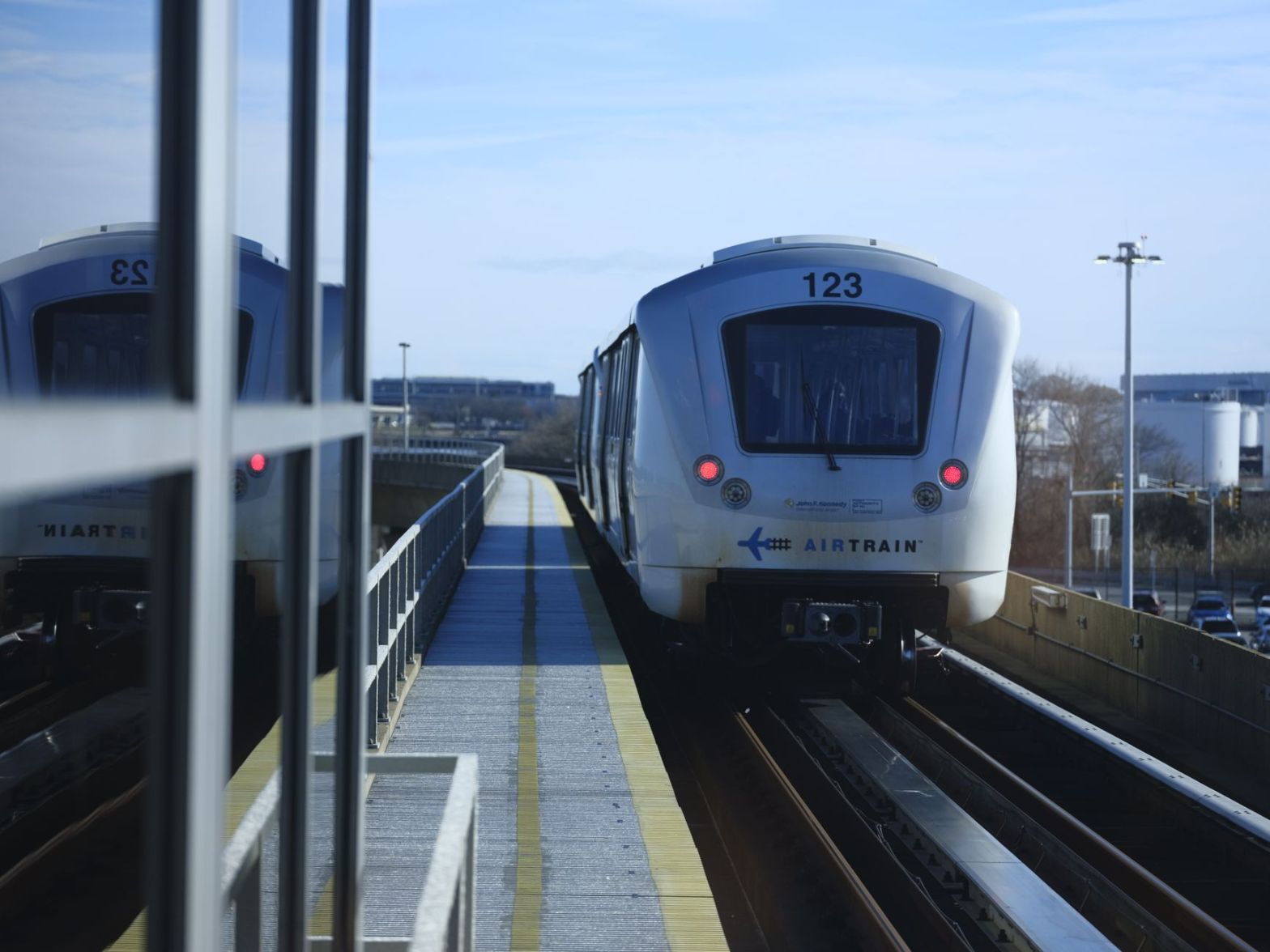
I’ve been a periodic user of the JFK AirTrain since that airport shuttle from the New York City subway was birthed at the end of 2003. Over that time, I’ve seen the usage of this connector grow considerably, the nominal prices kept at a relatively steep level, and the rail infrastructure not change much. So, that led me to think this just might be a rare profit-maker for transit.
Four months ago, I sought figures from the Port Authority of New York-New Jersey, which operates the AirTrain as well as JFK Airport, to try to flesh this out. It is now safe to say I won’t be getting those data*, but we can do some approximations. And these support my hypothesis.
Helpfully, passenger data can be summoned speedily via Gemini AI. In 2004, it was easy to get a seat on the AirTrain. Paid ridership was roughly 2.5 million. (Unpaid riders, which are approximated, use the system to go between terminals or to or from long-term parking and rental-car areas within JFK. This larger contingent–which includes airport employees who use a designated lot, as well as some local bus patrons– never crosses the fare gates.)
If the AirTrain was slow to catch on, the fare structure might have been a shocker. It started at $5 for rides from the subway-line stops in Queens and Brooklyn–and the subway at the time cost $2. That’s for a 10-minute AirTrain ride, whereas the subway trip was likely much longer (certainly from Manhattan). For historical and quirky reasons, you can’t take subway lines directly to NYC airports.
Even though the AirTrain fare has kept pace with the cost of living–now $8.75–resistance to paying it has lessened. Paid ridership has grown steadily, to 11.7 million in 2025. Early counts for 2026 remained strong. Unpaid has grown nearly as much, proportionately, so the trains are often full, and the boarding platforms as well. Yet the automated fleet (no salary + pension + medical on board!) has been the same 32 cars since 2004.
You can’t do a linear calculation of revenue from the paid ridership because the Port Authority has implemented various fare promotions/breaks over the years to boost or maintain rider levels–which of course were decimated during the Covid pandemic. That’s why the actual receipts from the PA would be useful–maybe $90 million? Meantime, contracted upkeep is far from zero, even if the hardware has been constant. Still, it would take real miscues not to be operationally in the black.
Of course, there’s future investment to be considered–the PA is looking at a fleet replacement and terminal improvements–so a solid balance sheet for this tiny unit will help. Maybe the paying riders will ultimately get more for their pricey fares. –Nov. 24, 2026
*I initially contacted the PA press office for the annual revenue figures from 2004 on. Halimah Elmariah, the press secretary, quickly replied to ask what publication I was writing for. As is usual, I replied that at least initially I was writing for this blog–it is hard for any independent journalist to interest other platforms without knowing what the key facts are. Since then, crickets from the press office. So, I filed a FOIL (Freedom of Information Law) request with the PA. After several weeks, it sent me annual financial statements. Down in the weeds of those, I discovered that AirTrain financials are subsumed into the overall JFK Airport figures, of which they are obviously just a small part. I tried another FOIL request, noting this obstacle and asking for internal breakdowns not in the officially released figures. A few weeks later came the response: FOIL only applies to documents, not to “information.” Net net: If it ain’t in what we tell everybody, you ain’t getting it.

