Is Southampton Using Permits to Weed Out Commerce?

It’s common among preservationists on the East End of Long Island, N.Y., to regard the town of Southampton as lax in its allowance of development and other commercial concerns. There’s some basis* for that, especially in contrast to the town of East Hampton, but just as much reason to see dilatoriness in getting projects approved when time is definitely money. A recent example is the extended consideration of marijuana dispensaries. Because these are supposed to be fast-tracked under a New York state law, Southampton officials are being brought to account, and this week they were ruled against, as noted in the local Press. (In court in a different case, the town has fared better.) Now, there’s a political backdrop to this situation that puts it beyond the usual zoning and permitting processes: Under the state law, towns could “opt-out” of the weed-selling allowance, which some of Southampton’s neighbors did. But, led by its former supervisor, Jay Schneiderman, the town board chose to allow the shops, subject to siting limitations. Schneiderman said he worried about losing tax revenue by opting-out, especially given that dope can be sold regardless on the self-ruled Shinnecock tribal land within the town. In the event, a flurry of dispensary applications was received, and sentiment in Southampton (as well as the composition of the board) has changed. State law prevents an opt-in town from changing its mind, however, so an alternative is to slow-walk site approvals, perhaps mindful that delay could effectively mean denial to a startup business with mounting bills. That is what pot-shop enthusiasts say is happening (here’s the latest lawsuit against the town, over an abandoned Hampton Bays site). On the other side, opponents surely will give the officials grief over any dispensaries that do open. Much in the way, you might say, other groundbreakings in the far-from-chill Hamptons evoke cries of laxity.

https://www.27east.com/southampton-press/new-york-state-poised-to-strike-down-southampton-site-plan-review-of-cannabis-stores-2399286/

* At board meetings in town there can be a seeming chumminess toward developers’ agents, though this can stem from past relationships. Many of these hired guns are former town officials themselves.

When YIMBY Comes to a Southampton Hamlet

Providing “affordable housing” in the midst of a price surge on the East End of Long Island, N.Y., is challenging enough—but the additional political wrinkles that come with each specific project were on display this month at a community-board meeting in the North Sea hamlet of Southampton town. It took place not far from where the first English colonists landed in the area in 1640.

The session was held to air (again) reactions to a proposed 34-unit rental project on a wooded lot that had been assigned 5-acre minimum residential zoning. Such a classification is the result of past efforts to contain “overbuilding” in the town from smaller lots—this was before expense became such a consuming barrier.

North Sea sports much bay waterfront, with occasionally splendid homes and seasonal or weekend gentry, but most of it is populated with fulltime residents in more modest domiciles built decades ago. Back then, they could enjoy a wooded or small-dock retreat, removed from the Hamptons summer crowd along the ocean. Now they’re more likely to feel pinched by crowding around them and pass-through traffic much of the year.

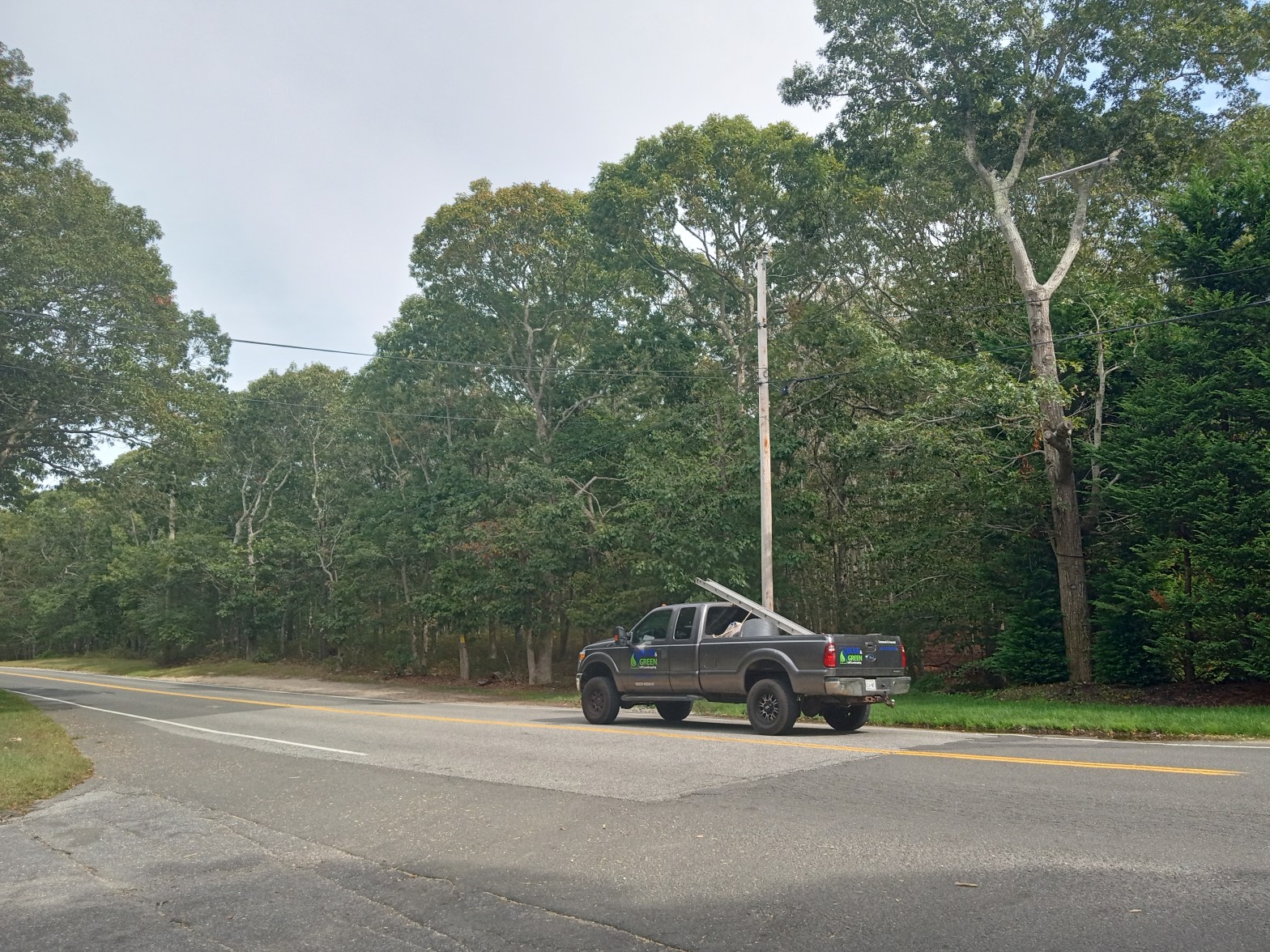
So the more outspoken residents there tend to have a chip on their shoulders about how the area is treated, compared to the grander parts of town. For instance, North Sea was relegated to hosting the town dump in generations past—it’s now a recycling center and landfill up the street from the planned apartments. And when it comes to heightened efforts to develop wage-earner housing in Southampton, some at this month’s meeting reiterated complaints that too many such projects are being “steered” into North Sea. A 50-unit condominium not far away from the one at issue was put through in 2005, and other neighboring lots are possibilities for more. This, in what is still a rural-seeming stretch, as the above photo of the 8.6-acre site under discussion shows.

The economics of construction costs and land prices usually demand attached, multifamily buildings to achieve affordability. But this is not what many existing homeowners want. Stephanie McNamara, who chairs the community council that hosted the meeting, explicitly prefers half-acre, single-family plots—the way it used to be in North Sea. (You won’t find many such properties at under a million dollars now.) So far, her group has won concessions in that direction from the town’s housing administrators on a few subsidized developments.

But the “Epley” project (so called after the prominent Southampton family member proposing it) is more attuned to market pricing—and dense.  Because it wouldn’t take government grants, said supportive town councilman Bill Pell at the meeting, it could limit tenancy to participants in the local workforce. This is a popular notion—versus the idea of unselective “affordable” units going to undesired outsiders or opportunistic part-timers. The Epley rents, though, reportedly would begin at $2,500 a month, which prompted skepticism about who in that workforce could cover that.  “Would you want it to be less?” a supporter fired back.

The 40-some attendees (an unusually large turnout for the monthly gatherings) heard from two elderly volunteers for the North Sea fire and EMS services that a dearth of younger nearby recruits—who can’t find starter residences—means untimely responses when those longtime homeowners may call for help.  (North Sea, like many parts of Long Island’s East End, relies on volunteers for some emergency services.)

So the evening went, back and forth.  “A pig is still a pig!” even with the lipstick of local preference, one voice sounded. Road dangers and water pollution also figured in the opposition’s arguments. A minority joined Pell in emphasizing the unmet housing demand. Soon he and the rest of the five-member town board will have to decide on the change of zoning for the Epleys to proceed. If that goes through, hearings will follow to fine-tune the development, likely shaving the unit total and surely adding costs. Maybe it would then still pencil out and get built.

The YIMBY movement—Yes In My Back Yard—to erect more housing in America’s cities and towns has scored recent gains, particularly at the state legislative levels, where localized resistance is less dominant and the cries of a financially-stressed young population are heard. But at the ballot box, discontent is felt from an older set who have seen their familiar settings already disturbed by economic upheaval—from both wealth and poverty.  New York’s governor Kathy Hochul, a Democrat, entered office with a forceful housing initiative but backed away as the suburbs rose up against her party. (A substitute initiative hasn’t satisfied everyone, either.)

If all politics are local, as the saying goes, it’s worth tracking the course of YIMBY in North Sea. –Sept. 29, 2025

Asking for Relief to Hellish Hamptons Street Traffic

The traffic snarl and its side effects on the South Fork of Long Island have been a longstanding but worsening problem. Various efforts have been mulled or tried to alleviate it, though few would revisit the fateful decision a half century ago not to build a bypass to the sole east-west highway–which is often clogged. To deal with the acute issue of trade and other vehicles seeking to conjure such a bypass by using residential roads, the trick is to find a measure that would deter such maneuvers but doesn’t rely on town police enforcement, which is sparse. I’m focused on putting “humps” in the roads, thus forcing drivers to slow down or choose a different, smoother route (the highway). They’ve been employed in three independent villages within the town of Southampton, including Sag Harbor. Presumably, a lot of pass-through trips*, particularly those made by heavy-duty commercial trucks, would get re-thought. So I framed the matter as a ripe political choice for this November’s election, in the following short letter appearing today in the Southampton Press:

https://www.27east.com/southampton-press/deciding-issue-2396411/

*It’s estimated that as much as half the peak traffic through Southampton in most months is destined for sites east or west of the town.

There’s No Ducking What Curbed Long Island Farms

The agricultural history of the gentrified East End of Long Island is preserved in spots today through pricey row crops and vineyards that were not part of the early 20th century action. Back then, the big harvest was potatoes and there were plenty of local dairies and duck farms. This week’s edition of Dan’s Papers out of Southampton has a solid retrospective on that last sort of agriculture–or more precisely, aquaculture. As the article notes, it was the fouling (fowling?) of local waters that greatly spelled the near-demise of the once-famous local duck trade. Nostalgia for the old days, before incoming urban wealth displaced so much of what shaped the East End from the 1970s, sometimes masks what were real problems then. Pollution of the marvelous bays and ponds didn’t begin with the suburban septic tank (an odd manifestation of today’s greatly-unsewered Suffolk County). Likewise, the crude farm-labor practices of that era–briefly mentioned in Dan’s Papers–would not survive today’s scrutiny. Yes, rapidly escalating land prices (and their tax implications for family farms) had much to do with depleting the region’s agricultural base–on the waterfronts more than anywhere else. But most duck and other farmers of the 1950s could not have handled the environmental and workforce cost structures that exist today. That’s why “farmland preservation” efforts are mostly for token effect, even if their visuals are a nice reminder. (Here’s a recent article that describes the circumstances of Hamptons farming and its “$30 berries.”) –Sept. 7, 2025

Text Journalists Should Stick to Their Keyboards

I’m sorry to be seeing and hearing so many of America’s ranking journalists. And why is that?

The mission of the journalist is to Find Stuff Out, and ideally convey the Stuff clearly, concisely and accurately. That’s why we bemoan the shrinkage and even closure of so many news staffs, particularly at the local level. We don’t find out.

In order to survive and even thrive in this new media environment, news organizations believe they must “engage” better with their intended audiences. Part of that strategy now entails various interfaces: podcasts (audio and video), other forms of on-camera appearance or narration, and live events for targeted subscribers or clients. Increasingly, traditional text journalists–not just those who’ve always done TV or radio work–are out front for this.

So, we get to hear these reporters and editors recapitulate their news, sometimes in sound or video bites, sometimes in conversations with each other or with a moderator who “interviews” them. At an event, the journalist may exchange on stage with a notable (or, I should say, even more notable).

In some ways, everybody gains from greater exposure to the people behind the news. For the boss, maybe this gets more productivity out of the talent–certainly more social-media sharing. But I’d argue that, with few exceptions, the hours spent producing this “content” is time not spent Finding Stuff Out. Time not on the phones or the web, not working the beat with sources. Ultimately, we end up with less news per dollar invested (and there’s less of that, to boot).

In the olden days, some print people would get assembled for weekly broadcast roundup shows. Later, 24/7 cable news would fill minutes with such talking heads. I never learned much from any of that, compared to reading what they actually published. I still don’t think I’m gaining much from watching or listening to journos whose most useful tool remains a keyboard.

Data Factories Within Reach of the Hamptons?

Squaring New York State’s stringent green-energy law with the looming demand for power-intensive data and AI centers is going to be hard enough most places, but especially on Long Island. There, long-standing grievances against the electric utility, now known as LIPA, that date back at least as far as rejected nuclear-plant aims from the 1960s hang over any such project. So this week’s report in Newsday about a 550,000-square-foot data facility being eyed for a developing area of Brookhaven town west of Southampton should send up the red flags. As with all sizable commercial or residential growth in Suffolk County, this will be subject to intense scrutiny and review that only the most bulletproof plans are likely to survive. (Not only energy but water usage is a factor in these East End environmental studies, on top of traffic, biodiversity, etc.) The results may have a lot to say about whether economic dynamism has much of a future in an area where most voting residents are comfortably situated to enjoy the picturesque surroundings as they are. –July 19, 2025

https://www.newsday.com/long-island/computer-data-center-warehouse-yaphank-hfdnl8i8

Moneyball 101: Reloading and Releaguing College Football

“College football” is not only more like a professional game at its higher levels these days, but it is also as much of a business story as a sports one. At the moment, the phenomenon of NIL (name-image-likeness) payments to the athletes is focusing attention on Texas Tech University. For years, Texas Tech has had interesting if uneven teams, rarely competitive in the top ranks. But, being Texans, boosters of the school are sparing no expense trying to bring the Red Raider brand to the pinnacle, a national championship, through recruitment.

Whether money will talk louder than anything else, including tradition, location (Lubbock, TX) and even the instruction leading to a degree, is uncertain. That’s what makes this an interesting business case study as well as a game-day test. The existence now of a “transfer portal” that allows the hired heros essentially to be free agents during their college years, moving from program to program with no interruption in their eligibility, adds to the commercial challenge.

These kinds of situations aren’t limited to the quest to be No. 1. At various ranks, moneyball is making for hectic change. Take the great realignment in conferences, which comes down to grabbing greater TV or streaming payments to the schools for showing their teams in action (so that more people will bet on that action, but that’s another story). Some athletic conferences are worth more than others, so college presidents have been chasing spots up the ladder, sometimes consigning their student-athletes to distant trips as a result. You see this even at the lower rungs of the ladder.

Take the case of Northern Illinois, which for 28 years has belonged to the Mid-American Conference (MAC), a league of long-established but “smaller school” football teams in the upper Midwest. The Huskies, as these Illinoisans are called (“Illini” is another, “bigger” team in the state), haven’t exactly dominated the MAC but they have risen on occasion to national stature. Last season, they were the only team to defeat Notre Dame until the national title game, when the “Irish” were defeated by Ohio State.

Now Northern Illinois is going to leave the MAC, for football only, beginning in 2026. They will join a revamped Mountain West Conference, which because of other realignments is less of a Mountain West grouping but is still way west of DeKalb, IL. This will mean lots of air travel for the Huskies, including sometimes to Hawaii (a conference member). That will increase costs. Northern Illinois hopes that the Mountain West will get a TV contract that will help pay the freight, but perhaps more important, the new conference is a better opening to the College Football Playoff, the lollapalooza that leads to the national championship. Yet a berth in that spectacle is still a longshot, even if the Huskies win nearly all of their games.

Curiously, cable TV money cuts two ways in the case of Northern Illinois. Its current Midwest regional conference features an unusual schedule in the latter half of each fall, with many games played on Tuesday and Wednesday nights. This is in order to get live coverage on the ESPN sports networks, in a feature called “MACtion.” It does give these usually obscure programs more national attention than they’d get on a busy weekend, but doesn’t suit alumni who might drive 65 miles from Chicago to see a home game on Saturday but aren’t likely to do it midweek. (Likewise for the student body–attendance at these games is minimal.) The new arrangement could sit better with this important constituency.

So many factors are at play in the new world of College Football Inc. that the coursework in Sports Management, an ever-more popular major for the matriculants who wear the team uniforms, should get all the richer. Just like lots of those players themselves. –July 9, 2025

Hamptons Living With a (Tree) Farm View

In the hypermarket that is today’s Hamptons real estate, a property bordering on an agricultural reserve has a powerful selling point. Anyone with a few million can have a McMansion, but is your vista protected from somebody else’s development?

Still, there are reserves, and then there are reserves. And what I picked up from a conversation this week with John vH Halsey, president of the Peconic Land Trust, is that most “farmland” held in reserves on the East End of Long Island, N.Y., is not actually tilled soil, the kind of pastoral setting that might come to mind. In fact, he says, in all of the 89,728 acres that is Southampton town, only 300 are fully and officially kept for cultivation. The rest in reserve has been set aside in various land arrangements that can be a far cry from the farmland-preservation goal that has animated Suffolk County citizenry–if not always farmers themselves–for at least half a century. (Many farm families were most keen, instead, on keeping their property options.)

It was in the early 1970s that the weekend-luxury rush to the Hamptons took off, and with it the loss of its rich Bridgehampton loam soil to those homebuyers, to forced sales for estate and property taxes, and to the middling returns from potatoes and dairy. Much preservation effort–or artifice–has followed from that, with Halsey’s Trust group involved in many of the genuine deals. (It also looks after woodlands and watersheds.)

These days, depending on the several legal structures available, one may see not row crops but amusements for kids or adults (wineries, golf), boutique horse stables or–most likely–“tree farms.” This last category means commercial nurseries, serving the now-huge home landscaping industry on Long Island’s South Fork, especially.

It is an irony not lost on Halsey and others that the decades of actions meant to safeguard the character of the Hamptons, by such measures as rezonings intended to ward off suburbanization, have supercharged the high-end property market. This in turn fostered the demand for great gardens and screened parcels that summons the landscape designers and endless work crews that call on the satellite nurseries. (They also add considerably to the stunning daily “trade parade” of traffic from west on Long Island.)

It can be argued that the result adds much beauty to the Hamptons (the now-ubiquitous “green giant” trees being a basis for dissent). But it’s a far cry from the mid-20th Century character of the area that many idealize, and that motivated the “save the farmlands” campaigns.

At the same time, the incredible wealth concentration on the East End has generated much charitable giving to the Peconic Land Trust to do its work, while also amassing a huge tax kitty from property sales since 1999 for set-aside acquisitions by town governments in the area. The Hamptons cycles, virtuous or not, go on. –June 27, 2025

Where North Fork Nuclear Almost Was

Nuclear energy was one of many development prospects on the East End of Long Island 50 years ago that are little remembered there today because they didn’t happen.  This month’s print edition of the East End Beacon, a news site concentrating on environmental and land-use issues with particular interest in the island’s North Fork, features an article that should jog memories. It’s about “Hallockville” and the water reactors that could have come to that historic farming ground at the east end of Riverhead town. They were discussed at the time as the Jamesport plants, though they actually were to be located not in that hamlet but in the one just above, Northville, on Long Island Sound. These were to be among a potential 11 atomic generating sites in Suffolk County to be built by what was then the Long Island Lighting Co—LILCO.  The idea, growing out of an early 1960s conception of nuclear energy as clean and “too cheap to meter,” was to supply low-cost power for the surrounding region.  That dream ultimately came fully crashing down in the last and most famous instance, at Shoreham in mid-Suffolk, where a plant was finished by the time sustained protests led Gov. Mario Cuomo to kill it in the late 1980s. Objections there from citizen-advocates were similar to those at Northville: inadequate safety, especially given narrow evacuation routes. That cause swept the day against nuclear power on Long Island. But beneath it lay a foundational objection, much as there had been at Hallockville in 1963 to earlier plans for an industrial harbor: Communities didn’t want economic growth if it meant (as it usually does) disturbing the character of their place. Yet even if tradeoffs are made—Long Island pays high utility rates for its stretched power generation—the bargain is not fully kept:  The North Fork today fights off development pressures on its remaining (strong) agricultural base.  Just as on the South Fork, however, the desirability of residential property has attracted the rich and made limited housing scarce for everyone else, so keeping things “as they are” is never quite possible. But in the place of growth we get preservation zones, such as at Hallock State Park where the nukes were to be situated.  Occasionally a contemporary visitor will find a marker telling him what he missed.  –June 5, 2024

A Sag Harbor Preserve…For Whom?

Sometimes land preservation doesn’t do much for the public, at least visibly. That’s been the case with an old dairy-cattle spread in New York’s Sag Harbor Village called Cilli Farm. This month’s article in the local Express weekly describes the nine acres as “a tangle of brambles, invasive plants and litter”–see the photo taken yesterday. This perhaps was not the intention 25 years ago when Sag Harbor, Southampton Town (in which most of it falls) and Suffolk County went in on saving the long dormant parcel north of the business district from being swallowed up in the real-estate revival that was taking hold in the historic village. Indeed, the onetime Cilli Farm is now surrounded by dense and very pricey homes and a vibrant waterfront. Often a motivation for setting aside open space is simply to retain greenery or vistas for the sake of current or future neighbors. But, if private capture was the primary result, a public expenditure–$1 million in this case—was of questionable value (even if a screaming bargain today). Sometimes preserving land is useful for ground-water protection, particularly on Long Island. But that has not been a central issue here. Nor has historic preservation, even though the Cilli dairy operation was a source of rich memories from Sag Harbor’s mid-20th century—nothing remains of it. It is just idle “park” space, with each level of government waiting on the others to initiate a plan for public use.  According to the Express article, two village parks stewards are spearheading an effort to clean up the site, improve access and offer trails to enjoy. The surrounding property owners may or may not like the activity that will bring.  At least, however, Cilli Farm will cease to be a local example of the tragedy of the commons. –April 18, 2025

https://www.27east.com/southampton-press/sag-harbor-village-board-hears-call-to-spruce-up-cilli-farm-2349899/