As the South Fork of Long Island saw a housing boom in the mid-1980s, development pressed into woodlands—the very areas whose environmental worth was finally gaining currency. Roughly 40 years ago, a pair of adjoining subdivision proposals north of Quogue Village drew particular press and public notice. Unlike several other large projects floated during the period, these two were ultimately approved and built. What was gained and lost as a result?
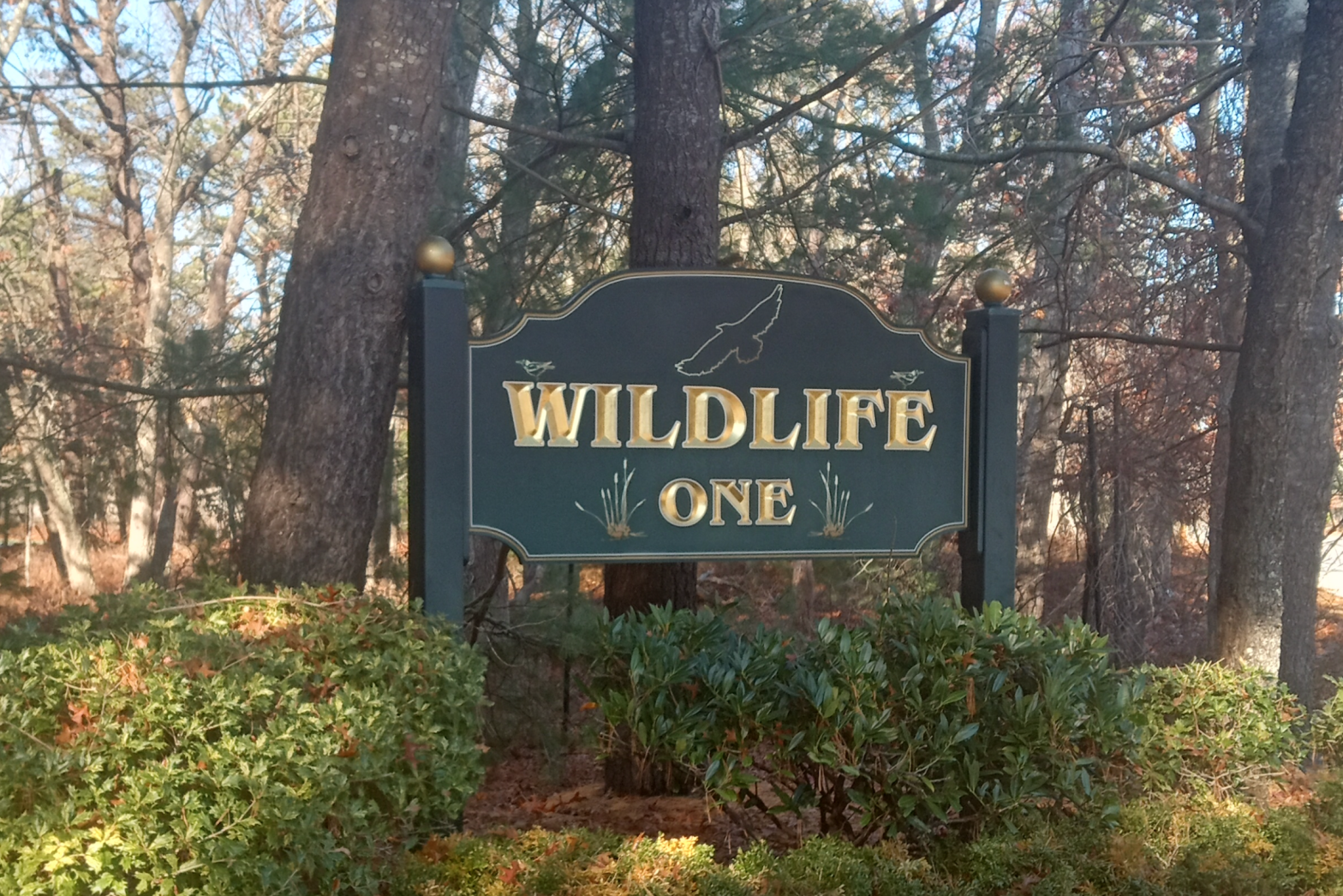
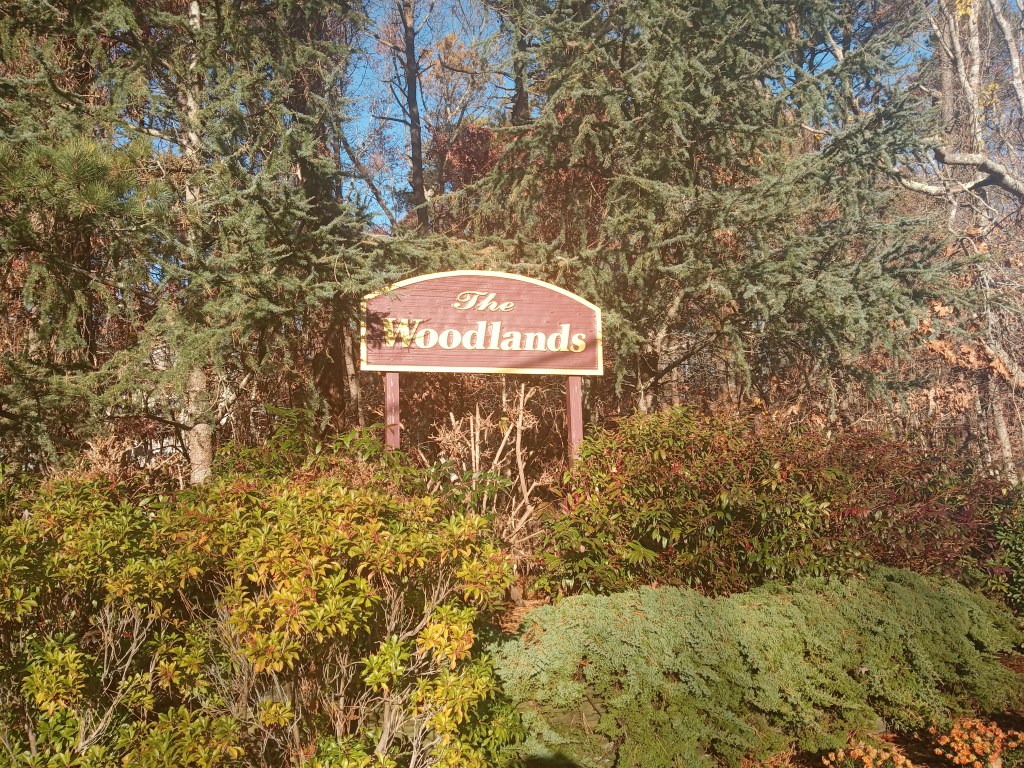
In the plans for what were called Wildlife Associates and Woodland Pines—today flagged by entry signs as simply Wildlife and Woodland—the few hundred acres between the Quogue Wildlife Refuge and County Road 104, north of Old Country Road were to become 200 single-family homes. Objections flew from the nearby village of Quogue, from Westhampton down the road, and from preservationists at what was then the Group for the South Fork.
The developers were guided through the approval process by a young outfit called Inter-Science Research, headed by former water-quality advocate Richard Warren. Inter-Science would go on to become one of the go-to shops for property applicants on the South Fork. In this case, a set of concessions–reducing the number and footprint of the homes and handing off a 100 acre “buffer” between the developments and the wildlife refuge–greased eventual approval. The town planning board, led by Roy Wines Jr., drew considerable criticism for such comprises during the hectic 1980s rush into the “Hamptons.”
(A history of the process must mainly draw from newspaper coverage at the time, which was more consistently attentive to development matters than it is today. Personal memories unfortunately have faded. Prominent local attorney Stephen Latham represented some opponents but is now semi-retired and his clients have also left the scene. Carolyn Zenk objected for what is now the Group for the East End—and later became a Southampton town councilwoman—but didn’t respond to inquiries, as Warren did not as well. An attorney who represented the developers also couldn’t be reached.)
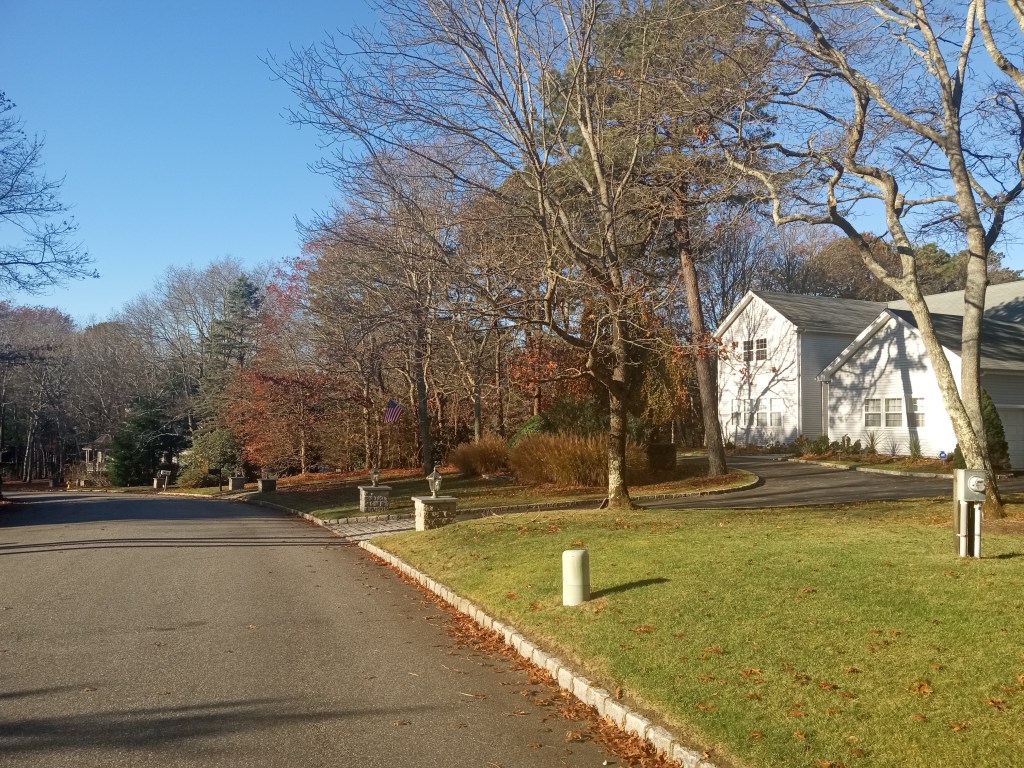
Forty years later, what can be seen? By most indicators, a successful settlement. The residential streets, most notably Whippoorwill Lane and Peacock Path, are populated with 128 moderately sized houses with a woodsy backdrop. (Prices have risen considerably, but most sell for well under $2 million.)The home sites bear a great resemblance to Whalebone Landing in Noyac, an early cluster subdivision welcomed by town planners. As family domiciles, they benefit from being part of the Quogue Union Free School District, one of the best performing in the state.
The Quogue refuge, meanwhile, has only grown in renown as Southampton town’s pioneering wildlife park, dating to its days as a private sanctuary the 1930s. Assistant Director Marisa Nelson told me that there’ve been no measures of feared harm to the sanctuary’s ponds (which share a watershed with the developments), no discernible effect on the fowl and mammal life, and only periodic violations of the buffer area for hunting or refuse. A recent walk along the perimeter of the refuge yielded not even a sight of homes or their outcroppings. A more noticeable presence, noise-wise, is the nearby Gabreski Airport, operated by Suffolk County and due for expanded use.
East Quogue, the hamlet where the subdivisions arose, today maintains a middle-class character. But the gloss of the modern Hamptons is reaching it. A luxury home development with a private golf course is under construction barely a mile away, also approved after years of contention and in its case millions of dollars in lawsuits. Its go-ahead marked a rare defeat for the Long Island Pine Barrens Society, which took up advocacy on developments by the late 1980s. The stakes, it seems, have grown far higher in the four decades since the Wildlife and Woodland neighborhoods were born.
At the same time, maintaining some vestige of “affordable” housing (that is, beyond the richest percentiles) in or near the Hamptons has also become a focal point of public policy. This will require concessions of the sort that opened up the woods near Quogue 40 years ago. –Jan. 13, 2025
I’ve been waiting for the New York Post, which this month ballyhooed a coverage push into Long Island, to seize on a land-use story that captures its aggrieved-middle-class shtick. It’s the Shinnecock tribe’s rush to build a “travel plaza” (for starters) on its 79-acre adjunct site in a wooded part of the Hampton Bays hamlet, just west of the locally-renowned boating canal named for these earliest settlers. Construction of the giant gas station (officially recognized “Indian” peoples can sell without tax) along the Sunrise Highway is taking place in defiance of local zoning and abutting a neighborhood of homes that sell for less than the multimillions commanded on the east side of the canal–the true “Hamptons.” The Shinnecock have long eyed their so-called Westwoods holding for development; they say a bay-facing resort hotel will follow the fuel and convenience retail, and the neighbors further fear that once-quashed casino plans there will be resurrected. This is now a full-fledged political crisis in Southampton town, which includes the hamlet. The town council voted 3-2 just before the Christmas holidays to sue the tribe to stop the project, as the article below from the Southampton Press ably explains. The Press and the East Hampton Star, flagship weeklies on Long Island’s South Fork, are left-of-center editorially and support the tribe–thus contributing to a regional media vacuum that the conservative Post seeks to fill. The Hampton Bays homeowners complain that the town’s government, which is majority Democrat, neglected their concerns until the state of New York, which has its own beef with the Shinnecock, forced the issue. The hamlet has a longstanding grievance over being a “stepchild” to the richer nearby precincts. The only Republican on the town board has supported the residents, while the two most liberal members opposed the lawsuit against the tribe. So, in a twist, the GOP member is the most pointedly anti-development. Shinnecock leaders, meanwhile, brusquely won’t give an inch, asserting their own historical grievances. Underlying the pushback they face is an argument that Westwoods, which lies a few miles from the formal Shinnecock reservation in the town, is actually owned (in fee simple) by the tribe but is not part of its independent “nation.” Got all that? Maybe soon it’ll be distilled under a blaring headline in the Post. –Dec. 29, 2024
UPDATE 1/3/25: The Biden Interior Dept., in a letter released yesterday, sided with the tribe over its claim to territorial jurisdiction over Westwoods.
I have to disagree somewhat with my libertarian friends at Reason who argue in the piece below that New York City is stifling a “creative, organic” outgrowth of the food-and-drinks business by shutting down the pandemic-era street sheds. I do so for the same reasons I have veered away from a number of laissez-faire positions: Just too many impolite or arrogant people abuse the public unless held in check. In this case, the offense was a form of squatting: Restaurants and bars were given “emergency” leeway, after Covid had largely emptied many streets, to expand outward in what was 1) initially considered a safer dining space and 2) soon became additional floor space to recoup lost business from the lockdown days. Then guess what? They never wanted to leave the sidewalk or curb areas, even as most of New York returned to full throttle. However, there were complaints of rats and late noise, plus the obstruction. In the winters, some spots had few outdoor customers but it was a hassle to dismantle and reassemble the structures so for months they just collected dirt, debris and the occasional substance abuser. After a long political stall, the city finally made the sheds come down last month, to be replaced next spring only in approved areas and formats (with fees, of course). Reason’s authors are right that the bureaucracy will limit their comeback, and stretches of the city will be lessened. But that’s the thing with people who make their private pleasures or profit a matter of the commons: Some add to others’ enjoyment and some detract, and we only have one rule book to enforce decorum. Most displays or displacements are tolerable for awhile–live and let live–but then you have the chronic or obnoxious cheat. This is why we cannot enjoy the sweet liberty of natural order in many walks of modern life, especially when people are crowded together. Too many of them don’t behave decently anymore, if they ever did. My older but still libertarian self has less time for that.
So much can and will be said, but one helpful message to be drawn from this election is that politicians and policymakers should be deathly afraid of ever loosing the inflation beast again. Memories and aftereffects of the price rises of 2021-2023 fed into the economy being an overriding reason for ousting Democrats from the White House. This should be particularly useful in restraining Donald Trump and whoever he might appoint to the Federal Reserve from pursuing a monetary out from the looming fiscal squeeze that he has yet to address. If anything, Trump has ruled out significant steps to contain the budget deficit and national debt, promising only some Elon Musk magic along, of course, with tariffs and deportations that would elevate costs. If Democrats win the House majority, he will not gain social spending cuts even if appoints officials who will seek them. But there will be no free lunch from debasing the dollar and inviting another round of inflation, either.
New and potentially partisan battle lines over “affordable” housing–or overdevelopment, if you prefer–are forming in Southampton town. It’s a tussle that has shape-shifted over recent decades but is now resulting from New York Gov. Kathy Hochul’s carrot strategy with local governments. After Long Island in particular bucked her earlier plans to intensify residential building in affluent suburbs, the Democrat adopted a “Pro-Housing Community Program” to make grants available to localities that better behaved. To qualify, they must supply zoning and permitting data in support of a pledge to increase the housing stock by 1% a year. Southampton’s majority-Democrat town board is due to consider its application this week, and Republican council member Cyndi McNamara on Saturday flagged various neighborhood associations in an email about the effort. “While that [1%] doesn’t sound like a lot, it is roughly 500 units per year in the Town outside of [its separately governed] Villages,” she wrote. “We will also be required to pledge to streamline permitting for and enact policies to encourage a variety of housing, including ADUs [so-called accessory additions], supportive housing, multifamily and more.” Some of these–particularly supportive units–are hot buttons in Southampton, as a recent simplified New York Times story* recounted. So McNamara’s alert may interrupt what would otherwise have been a quiet maneuver to bring the town along with neighboring East Hampton (dominated by Democrats) in obtaining “Pro Housing” status. Whether piecemeal in its many currently low-density areas, or through extensive development in a relatively depressed part of town, the matter of adding to Southampton’s population–especially when done with density to shave cost–is not a purely apple-pie affordability question. –Oct. 20, 2024
*The Liberty Gardens project got entangled not only in the political personalities involved–namely, the outgoing town supervisor, Jay Schneiderman, who shepherded it–but in its location. It would be roughly adjacent to one of the last tracts of historically black-occupied homes in Southampton Village. Those blocks fought any traffic access to the development through their streets.
Most political commercials are about hot-button nonsense like which congressional candidate is against fentanyl, so I ignore them. But because Wisconsin is such a key U.S. Senate race, the campaign of its mediocre senator Tammy Baldwin paid to put an ad on the national broadcast of the Brewers-Mets game last night, so I watched. The video attempts to get overweight voters–Cheeseheads?–to prefer Baldwin to her Republican opponent Eric Hovde because he in years past said that obesity should come with monetary costs. Obviously it does have such costs (health care, especially)–the question is who should bear them. The people speaking in the ad, presumably real, are outraged that Hovde might seek to have them pay more for health insurance. Now, under Obamacare, pre-existing conditions are supposed to be a socialized risk, so applying that implied moral imperative we might say that those who are genetically disposed to be fat should not suffer a penalty. But plenty of “weight issues” are a function of life-style, so in those common situations I would side with Hovde’s past (and maybe present) sentiments. Yes, for the same reason tobacco users should incur a premium cost for their risky habits. Sen. Baldwin wants to stigmatize Hovde as a cruel, rich financier, and her tactics may work. They will do little to help curb obesity, which may finally be dipping in the U.S. (thank expensive Wegovy). Politics is a lot like junk food, and America is asked to swallow more of both. –Oct. 4, 2024
It’s no surprise to see in new figures from the St. Louis Federal Reserve that ethnic Asian households in America, on balance, do better academically and have higher incomes. Their achievement phenomenon is one of the great U.S. stories of the last two generations. But this summer’s study breaks down such success into at least two notable components. The first is the parental influence. Typically parent backgrounds, particularly the holding of college degrees, are a great predictor of offspring attainments. This is dramatically less so in Asian families, which means that more parents without higher-ed are nevertheless able to imbue study-and-advance ideas into their children. Socioeconomic circumstance needn’t dictate outcome. A second takeaway is that once in college, Asian-Americans rely much less on student loans (less than 17% of post-grad households carry this debt) than their countrymen. (The comparable figure in black households is nearly 62%.) However accomplished–more seed corn? more side hustles?–this avoidance in turn provides more running room for building wealth after graduation. We read much about lessened mobility in our supposedly class-stratified country. The Asian experience continues to belie this, and the data help to explain why.
Word has finally come of a planned closure of the Kmart store at the Bridgehampton (N.Y.) Commons center. When this occurs next month, Kmart’s remaining presence in the continental U.S. will be nearly gone, but the other story here is what becomes of the giant commercial space in increasingly tony Bridgehampton. Word is it will become a Target, which makes retail sense, and offers a bone to the original motivation for the half century-old shopping complex, whose history I recounted here. The key tenant was originally a W.T. Grant; following its bankruptcy, Caldor took the least and for many locals, the whole place–the only true shopping mall in the Hamptons proper–became the “Caldor center.” By the time Kmart in turn succeeded to the site in the late 1990s, the area was already in full transition. The middle-class, year-round population that was to be serviced by a low-priced retailer, a key promise of the original developers, was thinning out. Bridgehampton and surrounding hamlets are dominated by wealthier “second-home” residents. A working class primarily commutes in from the west. If a Target can manage to bridge that day traffic with an “affordable chic” appeal–while at the same time not becoming a congestion node that will trigger already-stirring protests–it will help to complete the evolution of the modern Hamptons.
Robert Caro has gone on to greater national fame with his (still in the works) biographies of Lyndon Johnson. But in the New York area, particularly, he is renowned for his work, The Power Broker, about local planning czar Robert Moses.
It is the 50th anniversary of the publication of that Pulitzer Prize-winning book, which searingly has defined Moses in the generations since his 1981 death. Countless journalistic and urbanist iterations–and even songs and shows including a popular play starring Ralph Fiennes–have drawn on Caro’s themes. What’s been lacking in the popular or even academic culture is much revisionism on those story lines. Might this milestone year be time for more?
In the first place, it’s generally forgotten (except where the book is still sold) that the subtitle of the work was, “Robert Moses and the Fall of New York.” Granted, such wording is often the work of publishers trying to seize on a marketing moment, and 1974 was the onset of Gotham’s great financial siege, so this may not have been Caro’s choice. But the wording obviously proved untrue in any larger sense: Within a decade or so, New York City was on its way to new heights. (This was less true of New York State, where Moses also held sway, but the subtitle reference is clearly to the city. In any case, the state’s issues had little to do with Moses.)
Caro’s primary indictment of Moses is that he arrogantly used his unelected powers to rearrange metro New York’s transportation network to favor the automobile at the expense of non-motorists and the general quality of life. He did so by trying and in most cases succeeding in putting traffic around the city–or sometimes through its neighborhoods. The result was that the car either traduced those areas or sucked the life out of them by drawing the middle class in particular to the surrounding suburbs. In the process, Caro maintains, Moses often created more congestion. Many pages of the Power Broker are spent on the hours that solitary drivers were stuck in highway backups going to and from the core city (usually Manhattan).
All the while, Caro details, Moses dismissed opportunities to add to the metro area’s mass-transit capacity. A particular beef was his alleged contempt for including train lines in the middle of his signature late-stage highway, the Long Island Expressway. It’s true that Moses didn’t see much of a future for transit, although he (a resident of Babylon, on the island) could be excused for interpreting a downward trajectory for such lines, including the aging Long Island Rail Road. (Caro has also dined on the observation that Moses himself never learned to drive, having been chauffeured through his reign.)
Whether increased expenditure on transit early on, using the expansive bonding powers of Moses’ Triborough Bridge and Tunnel Authority, would have staved off the “fall of New York” (in the 1960s and ’70s) is unknown. Of course, everyone would like signals, switches and other equipment not to have deteriorated and diminished commuter service. But as it turned out, the parkways that Moses laid out have proved more availing of the residence and work patterns of the modern economy than the hub-and-spoke configuration of most transit lines. The arterials that Moses created–heading into many parts of New York City–are vital to the big truck deliveries of today’s commerce. And, for better or worse, the Long Island Expressway brought Suffolk County at the island’s eastern end into the city’s ambit. People forget that until the 1970s, much of Suffolk looked to Connecticut for “city” connections, including broadcasts.
Highways also play a part in a second Caro indictment of Moses: that he was a racist. It is easy to believe, on the basis of recorded actions and words, that he was a white elitist of his time and place, tending to regard the plight of poorer blacks and Puerto Ricans as a function of their environments and upbringings. That partly drove his efforts at “slum clearance” in favor of higher-rise housing projects in greener surroundings (or for civic projects like Lincoln Center). His record there was decidedly mixed. It is also said, especially today, that his most controversial road project, the Cross Bronx Expressway, was the gutting of a functional if unfavored neighborhood. That is probably true, and the fumes from its traffic pervade the mostly people of color who live there today. But in the late 1950s when the Cross Bronx was undertaken, the residents were largely Jewish or ethnic Irish and Italian.
What has really limned Moses in this regard, however, is Caro’s narrative about the street overpasses on the Long Island parkways. As he told the story, Moses had them built low enough to prevent buses from using the thoroughfares and thereby reaching the beaches and other island retreats he had built for “the public.” To Caro, and all the histories that have followed his, this was a way to keep poor people (without cars) away. Moses and most lieutenants denied this, offering cost and design explanations, but the charge has stuck, long into an era when few are without the means to motor onto the parkways. Again, the Moses of his time was not especially mindful of everyday aspirations of those from the “slums.” But if his designs were overtly racist, what then–for instance–of the ornate, low-slung overpasses on the Merritt Parkway in Connecticut, built in the same era and without Moses’ involvement? Were these also venally drawn?
An extended discussion of this bridges matter appeared in one of the “fact check” analyses by Glenn Kessler in the Washington Post in 2021. It was precipitated by remarks of U.S. Transportation Secretary Pete Buttigieg that drew on the Caro formulation. Kessler’s verdict was muddled but he surfaced an interesting scholarly debate that rarely makes it into Moses recapitulations.
Recreation is one more dark or at least gray element in Caro’s depiction of Moses. The “good Moses” of the early decades, battling Tammany Hall and fighting for popular access to the grounds of Nassau County land barons, is in the book’s pages, if less remembered now. (In an interview for CBS Reports in 1961, Moses was asked if he approved of socialism. Yes, he said, “but not the Communist kind.”) He was always a proponent of public playgrounds, courts and fields, even on the pastoral grounds of Central Park. Caro faults him for skimping on black and brown areas. But Power Broker doesn’t mention sizable East River Park*, which Moses brought to the teeming Lower East Side in 1939. (The author had to cut about a third from his original manuscript, so perhaps it was there.)
On Long Island today, Moses is demonized as a big road builder whose damage to the natural environment was only limited by his failure to realize some big schemes. The signature memory–again, much thanks to Caro–is of a coastal highway that would have traversed Fire Island. The idea seems hare-brained, but was in keeping with Moses’ goal of enhancing public (via private-vehicle) access to beachfront. On the western end of Fire Island he rehabbed an isolated beach space into what became Moses State Park-Long Island (this rare naming for him lately being contested) with a causeway connection to usher in millions of visitors. An avowed pragmatist, he indeed may have had a developer’s eye for raw nature, but in the process grabbed choice parcels before private interests could seize the day. In the Hamptons, Moses gets scant lingering credit for achieving the area’s first major open-space preservations, at Hither Hills and Montauk Point state parks, by 1924 when he was the parks chief there, his first major post.
Caro told that part of the story, yes, but as a set up for Moses’ tragic culmination as a rapacious bigot. Understandably, as he undertook his opus, Caro was seeking to correct years of deference or even adulation accorded “Master Builder” Moses by most news media until the 1960s. (A 1959 NBC program treated him as an oracle.)** That would have served a valuable purposes had Caro’s 1,166-page take been subject to the kind of reconsiderations normally given historical figures. But for 50 years it has stuck as the last word on a man about whom yet much more could be said. –Aug. 29, 2024
* In a cruel irony, the park was named in 2001 for former Mayor John V. Lindsay, whom Moses detested.
** A notable exception to this chorus was the cultural critic Lewis Mumford. Unusually, Moses would cite him by name in his rejoinders to detractors who “never built anything.”
Go to many affluent communities in North America and you notice some kind of safe cycling path. Not on the South Fork of Long Island.
You do see, outside of winter, some intrepid bicyclists—occasionally I am one. A few streets have designated bike lanes, where vehicles shouldn’t be blocking, but rarely do these extend for long stretches.* Except for the periodic weekend bike rallies where there’s official escort and safety in numbers, it’s a hazardous activity. Especially is this true on the east-west corridors, where traffic of all kinds is barreling along tight roads to avoid congestion on the main highway 27.
Why this dearth? There’s the older explanation, and the more recent (30-plus years) one.
The long historical context is that the South Fork (aka “Hamptons”) became a destination without having a core vacation hub or even wanting to be a resort. It was a collection of old fishing and farming districts separated by woodlands even as wealthy people adopted it as a seasonal or weekend retreat. Everybody’s desire was to keep the beautiful place the way it was “before.” Result: no new infrastructure that would accommodate a larger and active population, including bike paths (and sidewalks). Way back when, kids in the area’s towns could bike ride along sleepy roads with little care–even to school! Then, one day in the gilding of the Hamptons, nobody could anymore.
Sure, some streets near the ocean are safe enough for summer pedaling. (Ocean Road in Bridgehampton has a bike lane extending all the way to the 27 Hwy.) Even fronting the coast, however, there’ve been struggles in the modern era. In Amagansett, garden-landscape shop owner Charlie Whitmore recalls his father and mother, both longtime local fixtures, pressing for bike lanes along the popular Further Lane-Indian Wells Road-Bluff Road coastal stretch in the 1960s and early 1970s. The East Hampton town highway department ultimately improved the pavement, and a bit of sidewalk exists, but there’s still no secure path there, or anywhere else on the East End.
This, while New York State is actually a standout in this vein. The Empire State Trail, using disused rail lines and canal sidings, is off-road for most of its 750 miles. A strikingly good asphalt section runs from Van Cortlandt Park in the Bronx past the New Croton Reservoir in Westchester County and then well into the Hudson Valley. (A stretch near Yorktown Heights is shown above.)
It’s not that riding routes don’t exist on Long Island. Newsday has spotlighted two dozen such paths, not including the newest and nearest to the East End, the North Shore Rail Trail from Mount Sinai to Wading River in Brookhaven town. The Trust for Public Land, pursuant to a $3.8 million federal infrastructure grant last year, is fashioning plans for a mostly-protected bike route through Suffolk County to Montauk—an attempt, along with earlier funding for Nassau County, to bring Long Island up to the New York standard. The East End’s section will come last, although a “conceptual” map for the South Fork appeared at the group’s website in April.
If that effort proceeds, it will have to surmount obstacles that met previous pushes, and here we have the recent (30-year) story.
In the early 1990s, well into the rush of Manhattan money to the South Fork, an initial bid for a cycling trail came from naturalist Mike Bottini, then affiliated with what is now the Group for the East End. Armed with potential federal highway money, Bottini laid out a route that hugged the Long Island Rail Road line for 12 miles from Southampton to Amagansett. After a slow build, it got support from both the Southampton and East Hampton town boards, and a four-mile stretch in the middle, heading east from where the SoFo nature center now sits on Bridgehampton-Sag Harbor Turnpike, went through Southampton official review in 1999. But by summer 2000, it was drawing flak from some adjoining property owners and others who thought money should go for road repair.
Nonetheless, a Southampton Press editorial in August 2000 said “the question, it seems, is not whether the path will be constructed, but when.”
Bottini persisted, stressing the route’s appeal in connecting various civic activity spots. The thinking was that the paved trail would have utility not just for committed cyclists but for a wider population wanting to transit between such sites without venturing onto hectic Montauk Highway. He met resistance in the village of East Hampton, out of expressed safety fears. Objections also came from an environmental flank: Friends of the Long Pond Greenbelt up the northern spine of Bridgehampton didn’t want pavement or cyclists crossing its preserved territory. (As it happens, the long-abandoned LIRR line to Sag Harbor runs through the Greenbelt.)
Bottini, by then representing a cycling group, was still pitching the idea in the Press in 2009. But a window had closed. Eventually that four-mile stretch amounted to a series of on-street bike lanes, not much different from what exists in other parts of the South Fork. The rest of the 12 miles were largely forgotten.
On-street lanes or “routes” (which have less demarcation) were the focus of an official Southampton town advisory committee report issued in 2007. The town board, still sympathetic to cycling alternatives, accepted the findings, which notably called for expensive widening of key routes. “Crucial,” the panel wrote, were Noyac Road along the northern tier and the primary “back road” vehicle alternative to Montauk Highway (27), which features Head of Pond and Scuttlehole Roads. These two are the inescapable east-west routes—narrow and busy with trucks and cars–for any cyclist wanting to go from town hamlet to hamlet east of the Shinnecock Canal while avoiding the 27.
Accepting a report, however, is not the same as implementing one. By 2008, a global financial crisis had put a (temporary) dent in the Hamptons ardor and political winds would shift. Although minor route enhancements with signage were made, the costly property acquisitions needed for road widening were not.
The issue came to the fore in 2011 when Tom Neely, then Southampton town’s traffic-safety chief**, led a “Complete Streets” drive to address cyclist and pedestrian concerns. The Scuttlehole Road stretch was central, but a new town highway superintendent, Alex Gregor, had been elected and he was not sympathetic. At a board meeting Gregor offered a figure approaching a million dollars for the cost of the project, and the idea sank.
Another repeated target has been the Noyac area bordering on Sag Harbor and the Long Beach bayfront. A formal cost estimate for bike lanes from Gregor’s staff in 2014 came to nearly $800,000, mostly for road widening. The plan came to naught. But the general area has stayed in “traffic calming” focus, and a decade later the town, using new state money, now intends a major sidewalks project there. Ostensibly it’s for children and other pedestrians, but cycling on sidewalks is legal in Southampton town (and most of East Hampton) so there is, well, room for maneuver.
Are the South Fork winds shifting back in favor of accommodating cyclists, either recreational or commuting? It may be notable that Suffolk County is increasingly courting tourism. Southampton town will soon end up with a short offroad stretch for biking as part of a Hampton Bays hamlet route linking Good Ground Park with Red Creek Park. East Hampton is eyeing parking fees as a way to fund bicycle lanes. For now, however, separation from vehicular traffic is one of many obstacles facing day-to-day cyclists, as a Quixotic East Hamptonite recently found.
The cost of any land acquisitions has burgeoned as homes filled many of the wood and farm lots over the decades, and each potential neighbor is a potential objector. The LIRR’s right of way is jealously guarded by the Metropolitan Transportation Authority, even if safe sharing was possible. (Low-cost hacks such as “Toronto barriers” do make it possible to separate bikes from ordinary road traffic.) The LIPA power line that cuts across miles of open moraine on the South Fork is inviting, but also has easement issues, as well as terrain that would require heavy grading in stretches—adding to cost and opposition. And, recalling Mike Bottini’s case decades ago, LIPA’s line is a long way from activity nodes.
Thus the TPL Greenway planners will have big hurdles to clear once their effort moves east. So far, so good—the Southampton town board agreed this month to participate. But seed money is only a start; the choices get harder. And to add to the mix, bikes and other two-wheel transit has become an acute token of cultural controversy across the U.S.—even in San Francisco as well as New York City.
In the meantime, cyclists on the South Fork will have to pick their spots…and times. Sunday mornings seem to be best, for what it’s worth. –Aug. 23, 2024
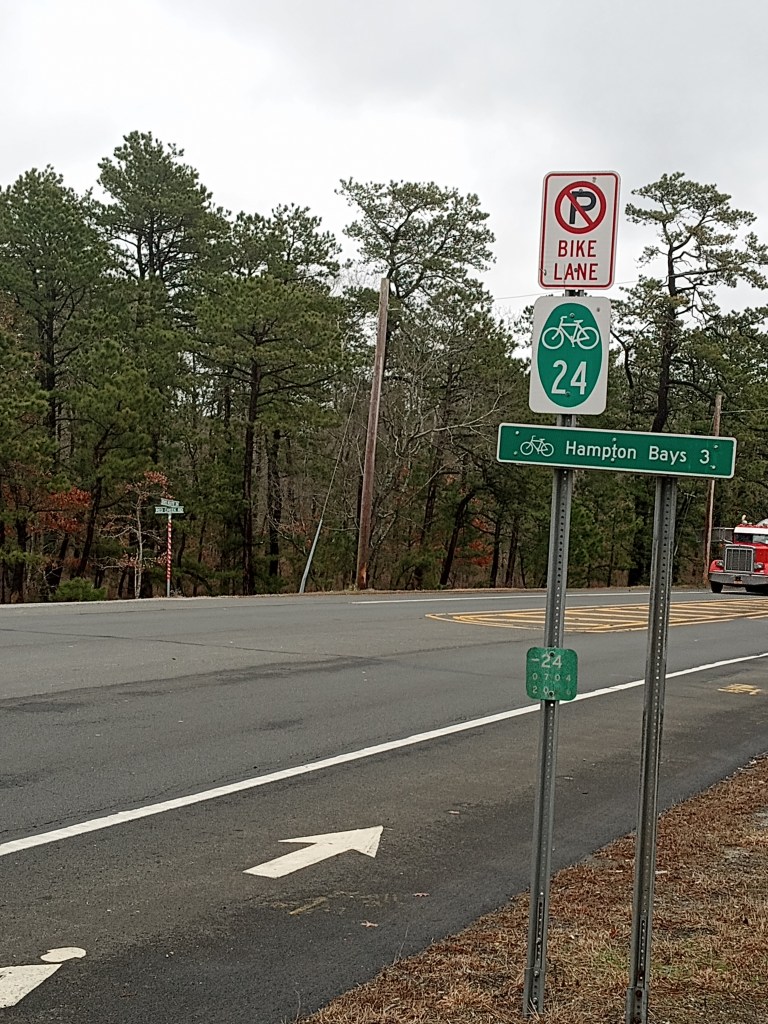
* An exception is the Flanders Road (State Hwy 24) lanes from Hampton Bays, as seen in the photo above. But with no barriers to the 55 mph (and higher) traffic, it is not inviting to most cyclists.
**Neely retired from the post but remains active as a transportation adviser to the town (and serves on its planning board). He ran for highway superintendent in 2021 and was narrowly defeated.



 Tim W. Ferguson