New York City, like many urban areas, has suffered vacant storefronts in recent years. The causes are likely many: online shopping, property crime, difficulty in hiring low-wage staff or paying the going rents. An article at politicsny.com this week notes that some city councilmembers are on the case and, as often, blaming landlords. Even a rare Republican on the council is threatening them with fines for, she says, “purposely” leaving space unrented. This is a frequent allegation in Gotham, both for commercial and residential space, based on suspected motivations growing out of the city’s tangled property laws. But what makes the charge ironic at the moment is that other landlords–or maybe the same ones–are accused of willfully leasing to the 2,000 illicit cannabis shops that have sprung up in the city since New York State legalized buying weed and tried, in a shambolic program, to channel sales to a reparations-based roster of approved dispensaries. Only a few dozen licensed shops have managed to open, but virtually every neighborhood has plenty of the other type. This has particularly incensed Gale Brewer, councilwoman on the Upper West Side (and former borough president of Manhattan). As the New York Times noted in a feature this month on her crusade, she is a “lifelong liberal” and “tireless tinkerer” who “had set out to prove how the power of government” could set things right. In fact, she has an ongoing interest in storefronts, having two years ago set after grocery-delivery outfits that were renting pandemic-emptied spaces as sub-depots and turning once-bustling blocks into dim warehouse strips. That problem mostly solved itself (the delivery craze subsided) but, in fact, there’s usually something in the naked city’s ever-changing commerce to cause political upset. Mayor LaGuardia rousted slot and pinball machines, and Mayor Giuliani closed porn shops. The thing about unruly spots like New York is that just about any human desire is met and, unless the law makes it impractical to do so, somebody will offer an interior to do the meeting–just wait. It takes a lot of tinkering to try to get the mix just right.
Dictator, Not Democracy, Initiated Korean Miracle
The most interesting aspect of yesterday’s discussion at the Korea Society in New York concerned Park Chung Hee, the transformative autocrat who ruled from Seoul for most of the 1960s and 1970s. He was an army general who seized power in 1961 and maneuvered, sometimes brutally, to maintain it until he was assassinated in 1979. But as the authors of new introductory volume to the history of the Korean peninsula, Victor Cha and Ramon Pacheco Pardo, note, Park was instrumental in creating the modern South Korean economy, which has subsequently flowered as the North sank into widespread misery. A key turning point came in 1965 when Park opened the Republic of Korea to relations and commerce with Japan, its historic tormentor. As Cha here suggests, this was a deeply unpopular move among Koreans and one that no democratic government, fragile or otherwise, would have countenanced. This is a development truth that must be kept in mind when promoting human rights in emerging economies–and is far from the only such episode in growth stories of Asia or elsewhere. The democratic ascent of the U.S.–itself one of limited popular franchise in our first two centuries–is a global exception.
The Housing Issue Begins to Bite
As we’re reminded constantly, the U.S. is an increasingly polarized society, politically and otherwise. It is getting ever more so “otherwise” in the housing market, where many enjoy rising property values and easy mortgage payments while others are pressed for shelter anywhere near their desired locations. This affordability issue has gained steam, and is causing political change followed by political backlash–so, more polarization. To wit: many comfortable communities, such as the New Jersey suburb cited in this Gothamist article from last week, do not want many if any lower-cost units added to their jurisdictions. This may reflect snobby prejudice or, instead, distaste for more traffic congestion, school crowding or environmental effects (e.g., sewage and garbage). In blue states such as New Jersey, legislatures increasingly are commanding–with the help of courts, as in this case–the localities to bend, either to affordable-housing quotas or to greater leeway for developers to build. It is easy to see how, from one side, this is adding to grievance that “liberal elites” are forcing putatively middle-class Americans close to home to succumb to rules that disrupt their preferred ways. From the other side, it’s a different coloration. Of course, housing doesn’t always cut so cleanly in politics–libertarians and many businesspeople favor greater construction opportunities, and not a few of the leafy-lawned suburbanites are left of center in their other lives. But in the 2024 climate, any dispute can send parties to the familiar outrage corners for settling matters…just how?
A Dollar Store with a Difference
A few months short of its 42nd birthday, the California-based sundries-and-more chain 99 Cents Only is going to die. An Orange County columnist for the Los Angeles Times delivers this fond obituary while visiting a store in Santa Ana that I used to patronize, and captures much of the appeal. He doesn’t mention the long-running, whimsical weekly newspaper ads (often joking on the 99 rubric) that helped set this retailer apart from the other “dollar stores”–now hulking national rivals–that grew around it, but he’s right about the distinction. As so often in business, the flavor came from the founder, instinctive merchandiser Dave Gold, whom I profiled in Forbes in 1998. His company earlier became a listed–and later quite hot–stock, and disheveled Dave briefly appeared on the Forbes 400 list of richest Americans. Even frugal Mr. Gold could overreach, however, and the company made an ill-fated expansion into Texas from which the stock never recovered. As the founder neared his death in 2013, the company was sold to private equity. What killed it a decade later–inflation? thievery? competition? California’s business climate?–will be debated. Dave was a Democrat so I doubt he’d blame the politics. “99” still had a loyal customer base, as this ode suggests. Maybe too much of the joy had gone out of its act.
https://www.latimes.com/california/story/2024-04-09/column-99-cent-only-stores-closing
Last Shot at New Golf in Greater Hamptons

When an 18-hole golf club—private and exclusive—opens in the next couple of years at the controversial Lewis Road luxury development in East Quogue, it will mark the latest and probably the last of 135 years of links building on and around the South Fork of Long Island. This will bring to 20 the number of golfing options, not including some favorites on the North Fork.
But long before it got to No. 20, the Hamptons made history with No. 1.
Shinnecock Hills, oldest incorporated golf club in the U.S., was the start of a first-wave of “summer colony” courses to populate the stretch. It took its name—and some say its land—from a native tribe that arguably had been hornswoggled by settlers decades earlier. But Shinnecock’s pedigree with golf professionals is solid—it will host its fourth U.S. Open tournament in 2026.
With the extended Long Island Rail Road opening up the territory to a new seasonal population, other courses followed in short order in the 1890s: the Westhampton Country Club (relocated in 1915), Quogue Field Club, Southampton Golf Club, the Maidstone Club in East Hampton and Gardiners Bay Country Club on Shelter Island. A decade later came National Golf Links, neighboring Shinnecock Hills on the Peconic Bay side.
The next burst of course creation occurred in the Roaring Twenties. The Bridgehampton Club opened nine holes near that village, south of the Montauk Highway. Soon, nine holes were carved out of woodlands east of Sag Harbor for a public club (today Sag Harbor Golf Course is operated by the state of New York). Another “executive” course, the Shelter Island Golf Club, was opened to general play. And in 1927, Carl Fisher’s grand resort vision for Montauk featured the initial iteration of today’s celebrated Downs layout.
As noted in William Quinn’s pictorial history, “America’s Linksland: A Century of Long Island Golf” (2002), several of the coastal courses were heavily damaged in the September 1938 hurricane that struck the area. The Quogue club lost a few holes and ultimately shortened to nine. Shinnecock Hills, meantime, had to shift some holes that once straddled the railroad tracks northward as the Sunrise Highway was extended into town.
New links activity went quiet for decades, awakened only by the golf craze of the 1960s. First came nine new public holes at Poxabogue in Sagaponack, in 1962. The membership course at Noyac Golf Club signaled new wealth in the mid-‘60s, inland from an old bay boating hamlet and existing, it says, as a “hidden gem” for years until a course redesign. (Noyac is the course depicted in the early-March photo.)
Meanwhile, tucked away in a forest of upper Westhampton, Hampton Hills Country Club opened in 1965. Remarkably, given later battles over the surrounding Pine Barrens, it attracted little controversy. (However, later proposals to build hundreds of homes along the course and by the Teamsters union to build 2,000 homes on property it held nearby did not fly.) Completing this era, Suffolk County in 1972 created Indian Island Golf Course around what had been a huge Riverhead duck farm.
Even then, however, the great change in the Hamptons was yet to come. One indication is a June 1964 advertisement in the East Hampton Star for the Montauk course: $4 green fees and “No Waiting for Starting Times.” Ownership would later shift to New York—and today it’s $86 for out-of-staters and a lot of luck could get you a prime spot on the tee.
A last push for golfing rights on the South Fork would be seen after the great Hamptons rush of the 1980s. By then, land values had begun to skyrocket—it’s generally accepted that at least 125 acres is needed for 18 holes—while a natural-resources lobby had grown unhappy to see fertilized grass stretches take the place of native terrain. Projects were floated for spots like an old stock farm in North Haven, only to fizzle.
Several golf-developer visions of the later 1900s failed to pass muster in the area, as local or state parklands or open space were approved instead. One of the last such efforts to die, in 1999, was at Montauk’s ocean-facing Camp Hero, a former federal installation given over instead to the public as rustic day-use grounds.
The increasingly vocal resistance complicated the founding of the next 18-hole course to open, the private Atlantic Golf Club in upper Bridgehampton. After a long battle over the 200 acres of onetime potato farm, with both competing developers and foes of any repurposing, Atlantic members—many of them from the South Fork’s growing Jewish community–realized their aims in 1992.
Almost a decade later and two miles up Millstone Road, another tussle ensued over the former Bridgehampton Raceway site on a rise overlooking Noyac Bay. Again, various interests including nature lovers sought to control the parcel. Ultimately the racetrack’s last impresario, Robert Rubin, put together an exclusive golf resort, The Bridge, to accompany a handful of fancy home sites. Rubin’s plans were sufficiently restrained to overcome opposition. But the approvals came just before the Community Preservation Fund, an East End tax designed to allow towns to compete for valuable and sensitive properties, could kick in enough to vie for the scenic site.
Meantime, an 18-hole membership course had opened in the agricultural belt above Amagansett with few fireworks. The South Fork Country Club, however, had the benefit of history. The locally prominent Bistrian family created a public 9-holer, the East Hampton Golf Course, on its farm plot there in 1978, before the landscaping graders became such a sore point. A new membership simply expanded to 18 and took charge in 2000.
The most recent course to open on the South Fork, Sebonack Golf Club in 2006, also avoided serious resistance. This may be explained by its location and pedigree: It adjoins the National Golf Links on what had been Bayberry Land, a banking magnate’s compound going back to 1919 and subsequently a retreat for the IBEW electricians union. Michael Pascucci spearheaded Sebonack’s creation with a “green” sensibility and ceded a long stretch of waterfront to Southampton town for conservation purposes. (With today’s polarized times, this has not satisfied all objections.)
In the nearly 20 years since, more affluent golfers have descended on the South Fork, with few openings for play. But development issues have only become more fractious and legally bound. So it’s no surprise that future golf prospects come in the form of a highly contested project. Lewis Road, formerly known as The Hills, is to be part of a 100-some home project over nearly 600 acres of woodland south of the Sunrise Highway. (See below for a shot of the site as of end of November 2024.) Just to its north are hundreds of protected acres of the Pine Barrens, and indeed the Long Island Pine Barrens Society was an early foe of the whole plan.
The current iteration of the project is four years old, and an earlier, similar blueprint failed after that long of a fight. But Discovery Land, the developer, has prevailed at all stops so far this time, and construction looms.
As hard fought as each additional golf hole has been in recent years, there’s likely plenty of demand to keep all the existing courses busy for Long Island’s eight-month active seasons. Thus, even with a generally-aging player population and high land values, closure of any of them for developments is a political nonstarter. (Increasingly, the bigger clubs have had to house maintenance workers on site, because nearby rental shelter is so dear.)
Reversion to nature preserves, as has happened elsewhere as golf supply exceeded demand, is an economic leap too far in the Hamptons. But there can be ancillary outdoor uses—the Southampton Trails Preservation Society has pitched an “accessible” visitor path on the donated bayfront stretch next to Sebonack, and created an unusual hike in the watershed of the Atlantic club. Enthusiasts asked for a trail as part of the Lewis Road project.
In years past, ample winter snowfalls created cross-country skiing possibilities on gently sloping fairways, but such cover has become rare on the South Fork. If anything, the warmer bridge seasons have brought more golf to a place that won’t be seeing any more spots to accommodate it. –March 15, 2024 and updated.

YIMBY Can Populate Conference Halls
This weekend’s New York Times article marvels over the apparent embrace of New Urbanist notions of densified and commercially active housing corridors by a seemingly fresh breed of market-oriented libertarians. They have come together under various banners of YIMBY–Yes In My Back Yard–to address a scarcity of “affordable” homes in many areas of the country. What the Times calls red-state Republicans are in fact policy wonks and some homebuilder allies who are channeling longtime philosophical objections to zoning and related restrictions on land use. New Urbanists often draw on Jane Jacobs but are civic planners to their core. The pairing of these traditionally opposing camps (they still are basically at odds over laws that set metropolitan “growth boundaries” or require subsidies within projects for low-income residents) is worthy of note. But as a political force, it is yet to advance beyond a few blue-state legislatures. At ground level, localities from Boston to San Diego are resisting changes in single-family-only zones that keep neighborhoods of a certain flavor (and price). This resistance itself is an amalgam of ideologies–from many of those “red state Republicans” to affluent professionals with Biden-Harris signs in their landscaped front yards. Maybe the phenomenon identified by the Times is one more example of shifting political currents in the country, although it does not reflect class divisions in the way other reorientations do. It really comes down to a simpler old adage: Where you stand depends on where you sit.
Ruptured Democracy? Add a Think Tank
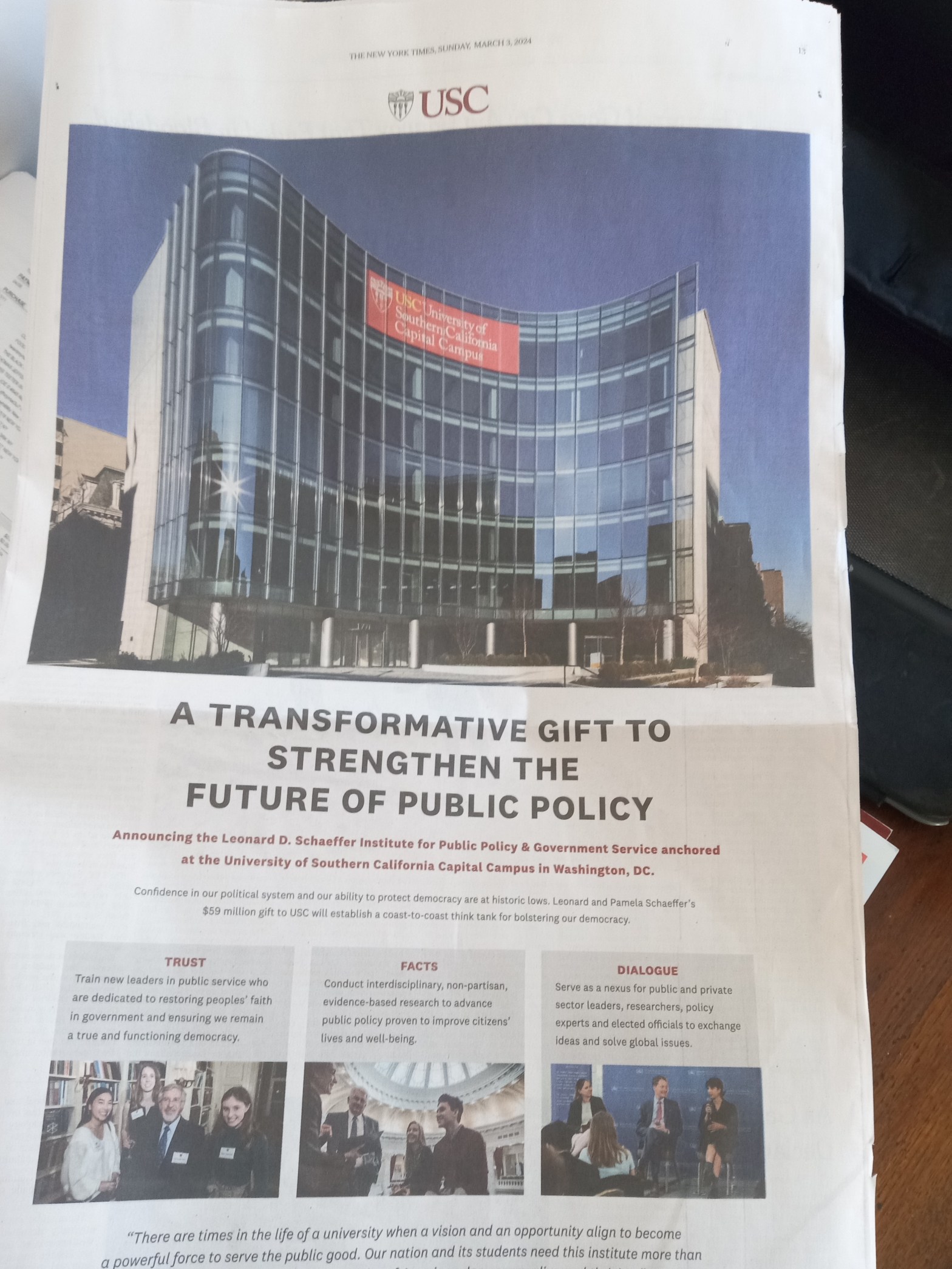
A full-page advertisement (there are still a few!) in today’s print New York Times salutes an act of philanthropy but is full of ironies.
The gift is $59 million from the HMO fortune of Leonard Schaeffer and his wife to the University of Southern California, for establishment of a (named for him) Institute for Public Policy & Government Service at USC’s “campus” (building) in Washington D.C.
“Confidence in our political system and our ability to protect democracy are at historic lows,” the ad reads. The gift “will establish a coast-to-coast think tank for bolstering our democracy.” The institute will “train new leaders,” conduct research to “advance public policy proven to improve citizens’ lives” and “serve as a nexus” for “public and private sector leaders, researchers, policy experts and elected officials to exchange ideas and solve global issues.”
So: Another glass-walled urban hive of modern America’s well-degreed class to formulate thinking about why so many of their fellow countrymen do not share the democratic propositions embraced by this elite. This does not seem likely to move the ball in 2024 and thereafter.
For all I know, USC trustee Schaeffer, who was the founding chairman and CEO of Wellpoint, is a worthy citizen–“a recognized expert and published author in health economies and health policy”–and means to contribute here. But with a fortune that derives from the medical-financial sector (Wellpoint is now called Elevance) that has helped alienate so many among the disaffected millions in the U.S., he isn’t the ideal benefactor of a forum for repairing deep social divisions.
Huge naming donations to richly endowed universities are another symbol of the rupture between the establishment and the estranged. Even with $59 million, this latest platform for proper civic intercourse may reach “coast to coast,” but will struggle to connect with a lot of what’s between. –March 3, 2024
A Twilight Strategy on Hong Kong

The grim progression of bloody autocrats in major as well as lesser quarters of the globe can make for personal and political paralysis here in the U.S. When Alexei Navalny is snuffed out in Russia and Vladimir Putin grinds on to occupy Ukraine, or when Xi Jinping stamps out dissent in greater China and pursues dissenters in their escapes, what is left for American “friends of freedom” to do?
That was on the table this week at a lunch I attended in New York City with two dozen others from news media or NGOs that support independent reporting. Hong Kong was the specific focus. Increasingly pro-Beijing officials there have trampled on longstanding rule-of-law protections for speech, and the worsening restrictions have swept up hundreds to jail and already (along with uncoincidental economic woes) led hundreds of thousands to leave the once-great city.
We talked mainly about Jimmy Lai, the 76-year-old former publisher of Apple Daily, the tabloid that the Chinese Communist Party most needed to–and forcibly did–shut down. The ailing but (according to his longtime aide Mark Simon, who was with us) still-earnest Lai has been locked up for three years now on trumped-up charges while the Hong Kong authorities orchestrate his main event: a show trial for violating the “national-security law” imposed there in 2020 and widened since.
Blessedly, remnants of pre-Communist Hong Kong have formed support organizations for Lai and other dissidents, most notably the Committee for Freedom in Hong Kong Foundation. Its president, author-journalist and ex-civic leader Mark Clifford, also addressed our gathering, held under the auspices of the Overseas Press Club.
We discussed the importance of lending continued independent media ears to Hong Kong’s stifled voices, even as China’s rulers seek to cite contact with Western interests as evidence of collusive sedition. More broadly, it is helpful to spotlight constantly the role of outside business, institutions and governments–especially the U.K.–in their interactions with a repressive Hong Kong and, of course, its Chinese masters. Beijing is bothered by the attention–this is why opposing sounds are silenced.
Many of us personally renounced our onetime links to Hong Kong long ago, but that of course was an empty proclamation. What is more meaningful is a sturdy chronicling of the suffering of those who remained under the tyrant’s lash (including Jimmy Lai, who chose to stay) and of the predations of a dictator and system with eyes on another target, Taiwan. The weight of world opinion is not enough at any particular point to force evil back, but ultimately it can bend history. The first order now is to deny cover to complicity with the thugs. —Feb. 23, 2024
He Comes to Bury the Tax Cutters

Michael J. Graetz long ago established himself as a nettle in the side of those who promote lower tax rates for economic growth–in recent times what’s known as a “supply-side” agenda. Today Princeton University Press publishes the Ivy League law professor’s book chronicling the last 45 years of that cause, “The Power to Destroy: How the Antitax Movement Hijacked America.” He traces the origin of the modern antitax push to Howard Jarvis’ finally-successful (in 1978) crusade to cut and limit property taxes in California. To Graetz’s credit, he has sophisticated awareness of tax politics, more than most Washington Beltway pundits. For one thing, he recognizes the role of the Wall Street Journal’s editorial page and even begins the book with a quotation from my former boss there, the late Robert L. Bartley. Graetz acknowledges what his adversaries were on to, and even concedes that some supply-side response to the stagflation of the late 1970s was “probably necessary.” His jaundiced view of tax-cutting legislation has undeniable elements of truth: much of the horse-trading was about gains for purely special interests, and the unwillingness to reduce the reach of government while cutting levies to pay for it has spawned enormous deficits. (The Laffer Curve for identifying when lower rates bring more revenues has been spongy in application—politicians and advocates aren’t inclined to find the apex and stop there.) As a result, tax policy has helped to foster greater inequality of result in America, whatever else it did. A shrewd defender of progressive, broad-based taxation should stop there—and perhaps acknowledge that the wealthy in more socialist societies abroad also find plenty of loopholes. Unfortunately, Graetz doesn’t offer even-handedness, instead making gratuitous political swipes that serve only to pigeonhole him as one more attack dog of the left. There’s the accusation of racial animus as a motivation for tax cutters (as a way to strike at black beneficiaries of the welfare state—but then what explains Jack Kemp?). There are numerous digs at peripheral right-wing figures, and of course at Donald Trump. (And when Trump’s 2017 tax bill aims to remove a break for the rich—the SALT deduction—he dismisses it as a slam on blue states.) There’s even a harkening back to the fall of Alger Hiss! Yes, in politics common cause is made with assorted forces whose agendas are ancillary to your own, and supply–side economists were no exception. U.S. tax policy is hard to separate from the right vs. left wars. That’s the reason Graetz’s book, for all its nitty-gritty on form 1040, bears a supportive blurb from the president of the ACLU. –Feb. 13, 2024
Chase Is Happy to Be ‘Just Another Bank’
This Wall Street Journal article of the past week spotlights the unusual (for today) strategy of opening numerous bank branches by the nation’s largest such financial institution, J.P Morgan Chase. It comes at a time when most other banks are retreating from the branch ubiquity approach, something many had embraced in urban areas not 15 years before–when New Yorkers often complained that a favorite storefront had been replaced by “just another bank.” It also comes as consumer banking in the U.S. and especially abroad is increasingly conducted online and among younger patrons by phone app. Chase–perhaps influenced by the success that upstart rivals like Capital One and TD banks as well as credit unions have had in marketing their customer-friendliness–believes the human contact is a pathway to provision of high-margin services to banking clients. The Journal reporter contrasts Chase’s stance with that of another giant, Bank of America. A starker comparison might be to Citibank, a New York City institution which today has no branch east of Holbrook on Long Island. That leaves 65 miles of some of the biggest wallets around (think the Hamptons) to the likes of Chase.
https://www.wsj.com/finance/banking/jpmorgan-chase-bank-branches-expansion-cc7973dc
 Tim W. Ferguson