
The East Hampton Star this week adds to the 50-year commemorations of seminal events on the East End of Long Island in the early 1970s, when its transition to being a weekend and warm-weather retreat for ordinary (but affluent) New Yorkers kicked in. This short article’s focus is the Hampton Jitney, the preferred connection for those Gothamites without personal transport. A longer business history could surely be written on the Jitney–a classic case of entrepreneurs discovering a need that others hadn’t identified. (In actuality, its service to Manhattan didn’t begin until 1976.) But there’s also the flip side of this success: the failure of the Long Island Rail Road to anticipate and capture this traffic. The LIRR, owned by the state of New York since the mid-1960s, has a rich history that includes connections to the South Fork (Hamptons) since the 1880s. Over the last 50-plus years, however, it has failed to offer easy, frequent and comfortable rides from convenient locations such that even a value-conscious adult passenger would choose its service over the Jitney and similar bus shuttles. Although a train ought to have speed advantages during periods of road congestion, the LIRR rarely achieves that edge. Despite a key right-of-way that it has maintained through decades of dramatic real-estate appreciation along the route, the railroad has played only a cameo role in the remarkable story of the contemporary Hamptons, leaving room for a once-lowly form of conveyance, the jitney, to assume modern appeal.
War Has a Way of Inspiring Migration

The world migrant population continues to rise–clocked at 281 million in what is still the last (2020) U.N. measure. There’s no reason to think it hasn’t grown since. The causes are well known: escape from tyranny, fear of persecution, hunger (literal, or for a better life), and physical exposure or danger. Often the last of these is brought on by wars that other people choose–or feel honor-bound–to fight. This is what a weekend article in the Wall Street Journal shows has brought tens of thousands of Russians and Ukrainians to unlikely destinations: Brazil and Argentina. (Of course, many more have fled the home-front’s killing and military drafts by seeking more proximate refuges.) Entry and work opportunities, as well as distance from reminders of what awaits any return, help to explain their trek across ocean and hemisphere. But this odd tale speaks to what has always been a lesser-told aspect of men’s battles: their casualties have included displacement. In modern times, America’s wars haven’t reached its continental shores, so the flight has been mostly from conscription. The Vietnam War produced perhaps 40,000 “dodgers” to handy Canada alone. Significant previous wars saw less-recognized refugees, going back to the Revolution (Loyalists) and the Civil War (on both sides). Patriotic fervor as in the two world wars might keep the numbers low for awhile, and favored sorts often find ways to insulate themselves in conflict, but before long mass slaughter drives people to uproot themselves. The silver lining, which may be true in Brazil and Argentina, is that those who shrink from war can grow to enrich both themselves and the lands that receive them.
When Anti-Mansionization Isn’t Just Meddling

The Wall Street Journal is catching up with the movement in the Hamptons and elsewhere to contain the maximum size of homes. This week’s article focuses on the aesthetic and probably sociological objections to the mansions (the biggest ones aren’t really “McMansions” because they are built to a scale that is not…er, scalable). In response, others quoted by the Journal speak to the property rights and general freedom of people to live as they wish. This of course is a valid claim in the USA, but what the story doesn’t get into are the externalities of these homes, which can make them other people’s business. On the East End of Long Island, the underground water table and the power infrastructure are such factors, but the most acute is traffic. The multitude of trade and other service workers that huge residences require, during and after construction, causes 14-hour backups on roads and residential bypass traffic that affects nearly everyone. “Philistines at the Hedgerow” is an old Hamptons tale, but the manifestations of enormous wealth in otherwise restrained settings is becoming a national conversation.
https://www.wsj.com/real-estate/luxury-homes/towns-rebelling-against-megamansions-7f35c9f7
Review of ‘When the Clock Broke’ by Ganz
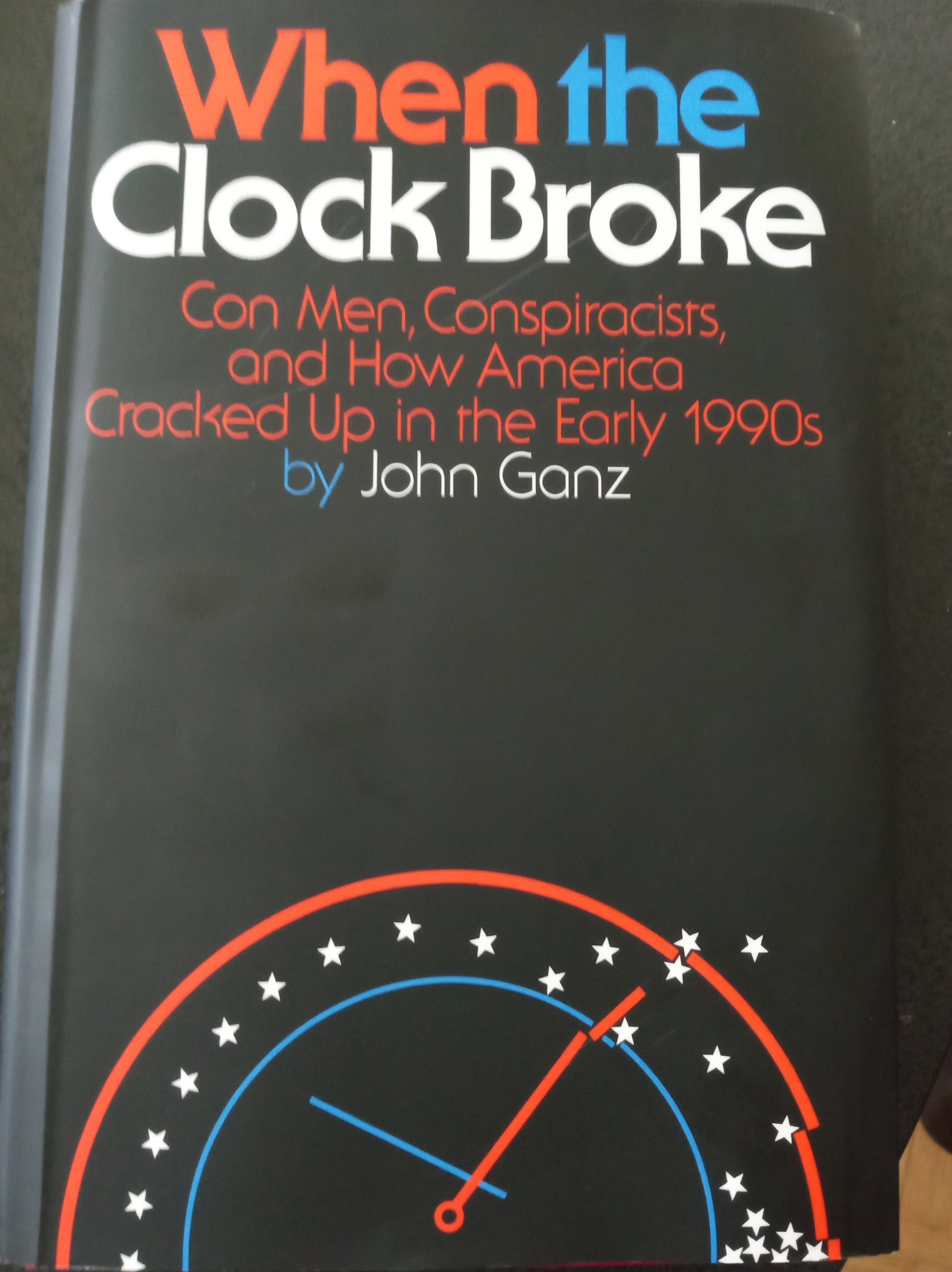
John Ganz is a trending young writer on the left with a history bent, and his new book from Farrar, Straus and Giroux, “When the Clock Broke,” is largely a political recapitulation of 1992 in the U.S. His angle is that the populist resentments of today’s MAGA America were present in that late-recessionary year, in which the country, having emerged triumphant in the Cold War, turned in on itself. (For his own fuller explanation, you can pay for his Substack feed.)
That’s an interesting proposition, placing the origins of the current distemper earlier than most others do. (Some trace them all the way to Andrew Jackson in 1828, but that’s a different discussion.) Obviously the Ross Perot phenomenon of 1992 and the related crack-up of the Reagan Republican Party under George H.W. Bush is a major flag for Ganz’s argument, and he mines the period for other useful omens (Pat Buchanan, Rush Limbaugh, Howard Stern).
Unfortunately, the author has a subsidiary aim and that is to find strands of fascist white supremacy in the unfolding drama back then (and naturally, now). So he references David Duke scores of times. The brief Louisiana legislative career of the former Klan wizard was ending as 1992 began, but Ganz sees his enduring influence in many places. My own memory of Duke is that he was a fluky, flaky presence in American politics, a footnote now like so many others of his kind. I had to check whether he was still alive.
That’s not Ganz’s only rediscovery. Murray Rothbard was an economist and cult favorite of libertarians for most of his career, until he veered into Southern populist swamps through the Ron Paul network. He merits a solid six pages–including a raring speech that inspires the book’s title–and a few other mentions. Just as obscure by general circulation was the paleoconservative writer Sam Francis, whose Manichean and racialist views are recited dozens of times, into the book’s final paragraphs. A forerunner of Steve Bannon? I don’t want to minimize the influence of the small, intellectual press but I don’t think Donald Trump would have ever read Francis, even if he had read at all.
I’d like to see more discussion of the angry populism of the time that was bipartisan. One target of this ire was NAFTA, the North American Free Trade Agreement, which Ganz notes briefly. He is good enough to record the fact that most congressional Democrats, and not Republicans, opposed the treaty when finally passed in 1993. I recall that year witnessing a union rally against the trade deal–held at the Port of Los Angeles by my own newly elected representative, Jane Harman. She would go on to rank as a notable globalist, but was not above a bit of pandering to Perotism then.
One other objection, a frequent and self-interested one of mine when it comes to pop histories of the modern American right. The Wall Street Journal’s editorial pages are cited once by Ganz, an apparently early (1989) gibe at Rudy Giuliani as a mayoral candidate.* The Journal was, during the period at issue, the largest-subscription newspaper in the U.S., and its opinion pages (which employed me then) were a bible for millions of conservatives. Arguably, its sentiments might have helped shape those times, in that camp at least? It is likely Ganz’s view that the “Wall Street” Republicanism often ascribed to the Journal’s editorials has been surmounted and supplanted by the movement he is writing about. That’s a fair position. But to have the Washington Times, by contrast, referenced on 16 pages is a bit skewed in this retrospective. Even if that narrowly targeted broadsheet did at the time employ the estimable Sam Francis!
Those reservations notwithstanding, I am glad to see a gifted next-gen writer draw on evidence from the analog era. Historical cycles do stretch, and then of course we are doomed to repeat them. I wonder what fruit today’s time capsules will bear. –July 15, 2024
*The actual citation is not included in the notes, but Giuliani at the time was still fresh off his prosecutorial frog-marching of investment bankers and conviction of Michael Milken, none of which endeared him to Journal editorialists.
Taking Hamptons Traffic Seriously

Here’s a “letter to the editor” from me, published this week at the Southampton Press site. It concerns the worsening traffic situation on the South Fork of Long Island, not only the backups on the primary east-west arteries, but the onslaught of diverted traffic onto residential roads (including–no surprise–mine). I make reference to some renderings that a full-time local resident with an architectural background, Jay Fitzpatrick, presented last month to a Southampton Town official committee set up to address the problem. I have met a few times with Jay and Barbara Fair, an involved citizen of the North Sea hamlet. Above is one of his preliminary works, showing what could be a bypass highway atop the existing Long Island Rail Road line. Such a bypass is a decades-old idea on the South Fork, which stirred earlier controversy and died. My letter argues that this outcome was unfortunate. Further background, including my own change of heart on this subject, is to be found in this 2022 post of mine. The idea remains a longshot today, but should be viewed as representative of what a meaningful response to the traffic mess could entail. (I should note that Jay makes the additional point that a bypass route would be of critical importance in the emergency of a mass evacuation to the west.) –July 12, 2024
Arf! Arf! Is a Hamptons Sound
Among the many 50-year milestones being observed in “the Hamptons” over the last year or two–reflective of the fundamental changes that were taking place there in the early 1970s–is a four-legged one. This golden anniversary year for the Animal Rescue Fund of the Hamptons (ARF), now a celebrated (and sometimes celebrity) charity, will culminate in its annual Bow Wow Meow Ball in August. This item from one of the free publications on Long Island’s East End gets into a bit of the history, but the fundamental context is that, by 1974, the area’s shift from an agricultural-fishing community with a smattering of summer beach wealth, to a year-around retreat for New York’s professional class, was in motion. The sentimentalizing of pet animals that (mercifully, in many eyes) accompanies a switch from outdoor farm to indoor house companions is a classic reflection of such transitions. ARF is not the only adoption shelter in the pet-happy area, but it’s become a big dog: in 2022 it had gross receipts of almost $5 million as it readied its latest expansion, a large indoor training hall at its headquarters in woods near East Hampton Airport. Range Rovers frequent the parking lot, even if more modest local volunteers and staff keep the place going. When the summer gala is past, the place gets more down to earth, but for the furry set of the East End, there will be no going back to the barn.
Dining Out on Taxpayers in NYC
Restaurant sheds have been a lingering point of Covid controversy in New York City, and this item in the free tabloid papers from Schneps Media ought to be reason for further debate. The sheds were allowed on public streets to save the eateries during the indoor restrictions of the pandemic. Many of them remain in place despite commerce returning to normal even in NYC, this despite complaints from neighbors about vermin, displacement of other uses and frequent unsightliness. Last summer the city council finally rang last call on the sheds, but gave the owners an additional year and the chance to maintain their public spaces with city-approved seasonal designs, which must be applied for soon. That was a big concession, compared with pre-Covid, but apparently not enough for some. Queens Congresswoman Grace Meng says she has secured $2 million in federal funds to subsidize participation of 60 restaurants in her district. So, for these 60 (and others to follow, elsewhere in town?), there will now be public space and public money for their private business. Of course, the food-and-drinks trade is rarely an easy one, and New York politicians with their laws are normally making it more difficult still, but in this case the happy hour is enjoyed by management. Street dining will continue, even if not everyone in town approves, and taxpayers in Des Moines may have their reservations, too.
Home Prices Tend to Level Out, If Not Off

Wait long enough, and many difference in residential real-estate prices get arbitraged away. That’s one takeaway, at least down to the metropolitan area, from this week’s data release from the Federal Housing Finance Agency (FHFA). It shows several instances of catch-up by areas of the country that have been less favored in recent decades. Maybe people still do move about America to seize on the “dream” of home ownership?
(A quick caveat: These FHFA numbers do not drill further down into zip codes or even towns. At that level, disparities in valuations can persist or even enlarge over longer stretches. The rich neighborhoods tend to stay that way.)
The FHFA release catches prices through the first quarter of 2024, comparing them back a few months, a year, five years, and since 1991. The last basis takes us back to the later days of the savings & loan crisis, so we can helpfully see the whole housing boom of the last 30-plus years. Longer time periods also help to correct for blips, such as the extreme days of the Covid lockdowns, although greater leeway for remote work is still doubtless a factor in recent trends.
So where do we see top price appreciations over the latest year? Would you believe, Allentown, Pa.? It’s number one, at 16%–and has a respectable 5-year gain of nearly 74%, vs. a U.S. average of 59%. You would not be wrong in thinking that the Allentown area has been a long laggard: up 228% since 1991, while American homes as a whole rose by 316%, or better than four-fold, in nominal prices.
Other metro areas that are making up for lost time include Rochester, N.Y., Camden, Buffalo and El Paso. Slowdowns, on the other hand, are evident over one- and five-year spans in San Francisco, Austin and Colorado Springs. So the larger snow to sun belt shifts occurring nationally (or as others would put it, blue to red) do not consistently hold.
Not everything evens out, even in 33 years. Wide price-appreciation gaps have persisted among losers: Honolulu (once a great winner), New Orleans and Fresno, for examples. Winners can continue to roll: Charleston, S.C., Miami and Fort Lauderdale, and San Diego. But broadly speaking, nowhere grows to the sky or sinks to pits of despond. The great multi-decade housing boom has lifted Salt Lake City by better than 675% and Hartford, Ct, by not quite 150%. Nobody went broke on equity alone, even if others really cashed in.
The FHFA also breaks down the nation by states, which is less precise but can yield political talking points. For the record, top recent and even 5-year gainers have been clumped in the Northeast (Vermont is hot!), with pandemic exceptions including Florida, South Carolina and the Mountain West. I must say, this surprised me. Also, it should be noted that the District of Columbia appears to be faring poorly in the big-government Biden presidency–it was the only “state” to decline in the latest year, and its homes appreciated less than 19% in the last five. But it had a good run through the Clinton, Bush 43 and Obama terms.
Many nonpolitical considerations account for these movements, but regression to a mean may be the most important. You have to live somewhere, and you likely wish to have “more” where you can. Perhaps my former Forbes colleague Rich Karlgaard had it right back in the early Aughts, when he published his book Life 2.0: How People Across America Are Transforming Their Lives by Finding the Where of Their Happiness.
Of course, it still helps to be able to pilot your own plane, as Rich did. Driving to Allentown, after all, is not that pleasant with all the trucks. –5/29/24
Bedroom Reform for Today’s Housing Crisis
Long Island, N.Y.’s East End has a housing price/supply crunch, like the United Kingdom. So it might want to look at an earnest argument out of the UK for addressing the scarcity by restricting or reallocating bedroom supply. (See this derivative blog post.) The scholars there found no actual shortfall of home square-footage in the British isles, but rather a hoarding of unnecessary bedroom space by a blessed slice of the population. Any Hamptonite (U.S. version) would quickly see how this applies locally, as McMansions with six or more bedrooms (nearly always with en-suite baths) are standard fare in new construction, and for only weekend or seasonal use in many situations. Back in the UK, the policy wonks looking for “fair decarbonization of housing” measures acknowledge that some potential steps for redressing the bedroom imbalance carry obviously awkward implications. So they promote instead a tax on insufficiently justified sleeping space. (There’s a bit of Henry George in that, and luxury-penalty taxes are a favored Hamptons recourse.). However, this doesn’t fully capture the social dimensions of the UK problem, which is no longer Downton Abbey estates but empty nesters of more modest means who hang onto oversized residences for lack of preferred alternatives. Thus, it’s a “tenure” issue, and one aggravated by the cumbersome ritual of unfettered private-property ownership–it skews space toward older people with deeds. If housing stock were better influenced by the state, bedroom space could be shuffled more easily among households as demographic needs change. The authors point to some Euro experiments. This more rational approach to domiciling appeals to certain academic minds, if not to the denizens of Long Island’s East End. One other reality check: The UK decarbonizers should make sure their own country’s “council” homes don’t share the static bias of New York City Housing Authority “projects.” Bigger apartments there, like those on fashionable stretches of Park Avenue, tend to stay with occupants who’ve aged beyond child-raising. Maybe, like the buyers of oversized Hamptons homes, they just wish to think the grandkids will come to visit. –5/28/24
*H/T to Rent Free, the Reason magazine newsletter by Christian Britschgi, for flagging this UK item.
Tipplers Tax: How NY Hamstrings ‘Big Grocery’
The antitrust-activist Federal Trade Commission (FTC) under the Biden administration and chair Lina Khan moved earlier this year to block a merger between grocery oligarchs Kroger and Albertsons. Its motivation is to preserve competition (such as it is) in traditional food shopping.
There’s a whole debate about whether choice in supermarkets is so relevant when many alternatives have arisen, both online and in physical stores from Walmart to Whole Foods to Trader Joe’s to Aldi and Lidl and even dollar stores. The marketplace, at least in population centers, does seem to keep offering ways to skip the old standbys.
But given the FTC’s current bent (it also has acted to bust a merger in branded handbags), where might concerted restriction of retail monopoly lead? Lessons can be found in America’s century-old regulation of alcoholic-beverage sales. In this case, I’d point to the curious case of New York state.
Other states have their own quirks, but New York’s general policy is to restrict wine and hard-liquor sales to specialized shops (often “mom & pops”) while leaving beer to food stores. As always, there’ve been lots of exceptions written into the law–the grocers can sell wine from New York grapes, or flavored wines, or wine-based coolers. But, in general, the distinctions have held, and the wine-liquor stores are well organized into a lobby that has fought vigorously to keep the boundaries. (That’s the reason, for example, that you cannot buy Costco’s popularly-priced Kirkland house-brand wines in New York–because Costco cannot deal in wine.)
There’s a flip side to this standoff: the liquor shops are prevented from selling food, even the snacks one might naturally serve with a drink. And they can’t, therefore, feature non-alcoholic beverages, even mocktails. Today’s article in the New York Post notes that the “package stores” are contesting this limitation, pleading poverty because alcohol-for-home sales are down (at least from pandemic binge levels) for various reasons. The back-and-forth in the Post’s account gives you a flavor for how petty this line-drawing has become.
Are consumers a winner from New York’s attempt to maintain an independent retail channel from being swept up by Big Grocer? (As well, of course, as to impose control on booze through special licensing.) Or might a more hands-off approach make it easier and perhaps cheaper to shop? If so, what might the nationwide lesson be for letting Kroger, Albertsons and their various rivals sort things out?
 Tim W. Ferguson